Showing posts with label inspiration. Show all posts

May 20, 2019

An Appreciation of John Wick

I was sold on the first John Wick movie after reading something along the lines of this on a movie forum:

Keanu Reeves avenges his dead puppy and takes on the Russian mafia.

My first thought was that this might be a goofy action-movie pastiche that would use a puppy as a story hook the same way the film Keanu used a kitten. It turned out that John Wick was serious--dead serious. And it worked because I was able to take it seriously, even with its bizarre world-building and absurdities. It was an easy-going revenge flick dripping in style and grit, fully loaded with impressive action choreography and gunplay. It wound up becoming a new all-time favorite because the story, so simple and clean, worked.

WARNING: SPOILERS FOLLOW 


It Was More Than a Puppy

John Wick begins in media res, in a scene at the movie's end. We don't know what happened up to that point, and we see nothing that's particularly exciting. It's a bit ironic that this great action movie doesn't start with action--it starts with our title character at his most wounded, literally bleeding his guts out as he pulls out a cellphone and watches a video of his dead wife. Within a few minutes, we already understand a few key things about John Wick: he's involved in something violent and dangerous, and he had a wife once who is now gone. When the title screen hits, we already have a few key story questions that become hooks: who is this guy? What happened to him?

Going back to the beginning, we are then shown John Wick's daily routine, which is somber, slow, peaceful even. There's no real action here either, but we see that he's alone and in mourning. This in itself becomes a conflict, and it's something we see in Keanu Reeve's performance, which takes these wordless scenes and exudes grief and pain out of everyday activities. Even watching him pour coffee looks ritualistic.

Before long, he gets the message from his dead wife and a delivery. To help him move on, he's given a puppy to take care of. It becomes his last remnant of a happier time. He's given hope, purpose, and something to live for (and all of this is explicitly defined later when Wick is tied to a chair, shouting at Viggo the reasons why it was more than a dog and why he has to go through with his vengeance).

These opening scenes may seem like the slowest portion of the film, but it's the most important. This is where all the heart is. The script and performers assign meaning to puppy, which in turn ties to a character who we see is in pain. We already feel something for Wick, and we care for him and his puppy.

So how to do you create a kick-ass action movie out of this? You take away the last things Wick has. Upon doing so, the film elicits outrage. You feel for Wick when he's beaten down and left with nothing. And for the rest of the movie, you root for him when he rises back up and gets payback. What we have with this film is a very simple but effective fall-rise arc. And with the use of the puppy as a personal attachment with deeper meaning, the film succeeds eliciting empathy for the main character. It does all of this within twenty minutes--that leaves another hour-plus for pure action.

Buried Remains

There is a mythic quality to these films. Part of it may be in the simplest of scenes--one in which Wick buries his lost puppy, and another in which he unearths the tools of his past life from his basement. There is an implicit irony to these scenes as they happen in such close proximity--Wick has to bury something he loved and lost, but he must also dig up something he previously buried and thought he left behind. The whole movie (and series) winds up revolving around Wick's inability to escape his past or let go. There's a literal underworld that keeps dragging him back into the fold, making it impossible for him to have nice things. He becomes the Boogeyman everybody talks about.

With the mystique of the film's underworld, it has a few world-building quirks that I've never seen (or perhaps can't recall right now) in other films. In Wick's world, there is some overarching criminal authority built on unspoken rules of conduct and civility--we see it shown (never told) as Wick interacts with his contacts and old friends. It seems like everybody at the Continental knows him--he's achieved legendary status through deeds we never really see or hear about. But we can tell it's significant based on the reputation he has with the high-rollers around him, and the fear he instills in experienced gangsters like Viggo. Through the reactions of other characters, the scant stories they tell about Wick being a Boogeyman who can kill with a pencil, we understand that Wick is a guy you don't mess with.

The places Wick goes to are hardly normal. The Russian mafia seems to always hang out in huge buildings with European facades and stuffy interiors where there are books, booze, cigars, and women. When Iosef is at the club, he's hanging out in its lowest level, which looks less like a usable pool and more like a underground river with vaulted brick ceilings. On top of all that, the mafia performs many operations beneath an elaborately-decorated church. On one hand, there is a sense of class to all these places, but they're simply masks for the underlying filth, crime, and violence that follows the mafia in all its activities. It follows Wick as well, and the Continental hotel achieves the same contrast--there are rules, codes, pleasantries, but Perkins and Marcus both violate those barriers to bring out Wick's violent, uncivil side. This generates the theme of civility vs savagery throughout the film, but even on an aesthetic level, it has a way of adding layers of myth over the criminal underworld. It's all the same reasons why I enjoyed the Noir anime series (and really, Noir and Wick seem to be cut from the same cloth somehow. If I had to write fan fiction for both, I'd mash them up in a shared universe just for kicks. Wick vs Mireille vs Kirika would be an epic gunfight).

What really pushes this movie (and its sequel) into "mythic" territory is what I see in common with another mythic figure: Kratos, from the God of War video games. Both Wick and Kratos lost their loved ones (different reasons--Kratos lost his family by his own rage, but Wick is dragged into things because people just won't leave well enough alone). Both characters seek revenge against higher powers. Both are subject to the rules and whims of higher authorities (as Kratos is punished and de-powered by Zeus, Wick is subject to the rules of "management" and runs the risk of "ex communicado" in the sequels).

Attributing Wick as a Boogeyman (aka Baba Yaga) makes him synonymous with a ghostly figure who stalks his prey, catches them unaware, and wreaks unbelievable havoc on his enemies. Kratos was always a blunt instrument who ravaged Olympus with sheer brute strength and rage--Wick is much more subtle, and with his slick hairstyle and elegant suits, he comes off as a more nuanced, silent, mysterious figure. It's perfect for a nightclub that looks like it's sitting on the River Styx, or later in Rome where there's a party on top of ancient catacombs. Parallels are drawn between the criminal underworld and the mythological underworld, and with Wick's thirst for vengeance, I can't help but to think of his continuous hellish descent as something ripped out of a Greek tragedy.

In the end, it's not just the puppy that goes into the ground, or Wick's off-screen wife. He descends into the ground often as well, so he can rise in the underworld.

Show Us Where It Hurts

He becomes a specter in his own way. Even though he bleeds and suffers, his sheer skill makes him nearly invulnerable. This would normally be a problem for a movie, since invincible characters don't elicit tension. You know they survive in the end (and we know Wick lives long enough to find himself rounded in some loading dock somehow), so you know his scenes at the nightclub, warehouse, and safehouse won't amount to him dying.

And yet, we are glued to his every move for a few good reasons:
  • This is an action film, and what sells it the most is the choreography. For films, this works because it becomes a visual art rooted in performance, skilled gunplay, and the camera's tracking (which is all exceptional in the film). We become wowed by what we see.
  • The film is just slathered in style, thanks to the steady cinematography, the unique camera angles, the neon-lighting. It's always interesting to look at, even in between the action. Once again, this is a visual trait that benefits the film.
  • John Wick may be a Boogeyman, but his fights rarely go perfectly. His first big fight scene at his own house goes pretty smoothly--he succeeds in dispatching every enemy, but we have brief tension when a cop comes snooping around (this becomes another opportunity to showcase Wick's mystique as the cop spots the bodies, asks if he's still working, then backs away--we are shown that Wick has a reputation that goes above the law). In the nightclub, he is stabbed in the gut and thrown off a mezzanine--he limps back to the hotel to be healed by a doctor, but not without the warning that his stitches could rip open again. So for the next round of action scenes, we see that he puts his own flesh and mortality at risk (especially when Perkins repeatedly punches him in his wound, presumably tearing it open again). In the following sequences, Wick is hit by a car or two, and is captured and beaten. He loses his allies and is betrayed by Viggo. It takes all this effort just to get to Iosef--everything seems to conspire to turn on Wick and kill him, and this is what makes the story compelling even if you know his sheer skill will win out in the end. It's the challenge and struggle that makes this work.
  • On the flipside of the above, there's another reason why it's exciting to watch Wick even when you know he'll live on in the end--when he does overcome his challenges and get back up, you are pumped to see him take out the bad guys (because we've been onboard with him from frame one) and we are interested to see exactly how he's going to get Iosef (and then Viggo) in the end. When we do see it all unfold, we become wowed by what he does.

Details Matter

What makes this film most palatable is not in how much is told to us with the dialogue, but how much is unspoken. So much of the film is shown to us and not told, and it works perfectly for many reasons.
  • As mentioned in detail above, everybody's reactions to the mere mention of Wick paints him as a legend without having to explain away who Wick is and why he's so feared. By seeing the reaction, we understand.
  • The rules and mechanics of management and the underworld are never explained in detail. We see Wick give out these gold coins--since these aren't ordinary currency, we understand that this is something exclusive to the Continental and the powers that be. When we see the things he uses this money on (cleaners, a hotel stay, a doctor who doesn't ask questions, a drink even), we see that there's an entire infrastructure operating invisible to the rest of society. Is it plausible? The film makes it look plausible, and that's all we need to see.
  • Codes and rules are hardly ever recited to us. All we hear is something along the lines of "don't do business in the hotel," but since we know whose these people are and what they do, we know that business doesn't mean mergers and such. When Perkins breaks those rules, we see the consequences, so we see that the higher powers have the pull and means to enforce their rules. Wick respects and obeys these standards, which not only shows us his place in this world, but also helps characterize him even further--he's a man who can show discipline, restraint, and honor.
  • And yet, we see at least two characters who chose to disrespect the rules: Iosef and Perkins. Iosef in particular is a punk and a coward--these traits are never told to us, but are shown in the way he whines, pouts, runs and hides. We already want to see him knocked off because he killed Wick's puppy--as the movie goes on, he just digs his grave deeper as he fumbles around. Perkins blatantly says "f**k management" and does whatever she wants to, killing one of Wick's allies in the process. Unsurprisingly, she pays for her disrespect. Little more needs to be said--all of this plays out before our eyes.
Be Seeing You

John Wick proves that you don't need much to make a great action-movie experience. As great as it is to see a movie loaded with pyrotechnics, special effects, and the like, Wick pulls it off with just a bunch of guys with guns in interesting locations going through fantastic stunt choreography, and filmed with style. But it all works because of the script, and the clean way it shows us the story instead of shoving exposition down our throats. It all unfolds in a way that lets us become drawn to the character's pain, before we follow him on his rampage and root for him to overcome his enemies and finally find peace.

Of course, with the sequels Wick may never truly find peace. His future struggles show how he continues to dig himself deeper into his own personal hell, unable to escape the past. But one can always watch the first film on its own merits, since it reaches satisfying closure. Wick got his payback, adopted a new dog--there's nothing more gratifying than to see that last shot where he's finally able to walk away with his business completed.

March 5, 2017

Al's Inspiration Shelf For Video Games

I've recently taken it upon myself to parse out some of my favorite things from my collections and put them on their own dedicated shelf. These will be my "inspiration shelves," containing media and things that will directly inspire and influence my own imagination and creativity. There's a shelf for books, film, and music. I don't actually have one for video games, but there should be one. So I plan on listing the games here that would be on an inspiration shelf if one theoretically existed.


My History With Video Games
I've had the good fortune to witness the rise of video games as a medium from the 80s onwards. My parents had an Atari 2600--I believe it was bought from a garage sale or from somebody else, and it came with a whole box of game cartridges. From that, we would experience a ton of retro classics--Dig Dug, Pac Man, Missile Command, Yar's Revenge, Berzerk, Pitfall 1 and 2, Dodge 'Em, Centipede, Asteroids, and oddles more. I even remember a cartridge for Raiders of the Lost Ark, which was interpreted in glorious 8-bit in a very weird and involving way. I probably remember the colors and sounds of these games more than the actual content. I also remember my dad could progress a lot further in these games than I could (especially Dig Dug).

Atari was what we had--we did not upgrade to Nintendo right off the bat. We did get a Nintendo console later on, probably used but I don't remember. I probably already knew about Super Mario Bros and Duck Hunt playing it on other kids' consoles. When we got our own console, it was Super Mario Bros 3 that wowed me the most--I loved the smooth gameplay, the map-style level selection, and graphic quality. I would replay that game ceaselessly, until I got to the point where I could beat the whole thing in 3 hours every Saturday morning. I also remember playing Gauntlet with my best friend, and he seemed to love it. I remember a RoboCop game (which was awesome), a Back to the Future game (which I liked, but could never get far in it), and a game for Indiana Jones and the Temple of Doom (which I remember loving, but couldn't get past certain parts).

When the Super Nintendo came out, I was enamored by the 16-bit graphic upgrade. I always loved Super Mario World, and it remains my favorite Mario game that I've played. It's smooth. It's well-designed. It's varied. It's full of secrets. And for once, it supports saved games. I played this game every chance I could get, but those chances were few and far between, because we never got a SNES console of our own. I would experience SNES games through other friends' consoles and at the rec center. I know I've seen and played other SNES games here and there, but I don't remember them.

Around 1993 or 1994, I laid eyes on a game that thrilled and excited me even more. It was Indiana Jones and the Fate of Atlantis, on a friend's PC. I was already begging my parents for a PC of our own for other, simpler games. Eventually, we got one, and I got to play Indy for my own. It was a marvelous adventure in its own right, and I always wished it could have been made as an official film of the series. The game had pretty nice graphics for its time--blocky perhaps, but everything looked as detailed and realistic as a game could get back then. The actual story was sprawling and had some very thought-provoking puzzles. I played it through several different ways (there are two possible endings and three possible paths to get there), and it remains one of my all-time favorites.

Other point-and-click games would dominate most of my childhood. First time I loaded Space Quest IV, I couldn't stop laughing--it was hilarious from the opening logos onwards. Finishing it would be tough, but I did it eventually. A friend would play Space Quest V and VI, but I wouldn't pick them up for myself until later. King's Quest VI was one of the first I played, and that was quite an adventure too--I remember mapping out the labyrinth to find all the pitfalls and rooms and stuff, it was a brutal trial-and-error endeavor to beat that game (and that also had a couple of possible endings, if I remember right). My grandfather bought me King's Quest VII and Star Trek: A Final Unity as gifts--both were phenomenal experiences I cherished (shame I never did beat the Star Trek one--didn't understand how to reach the end until I looked it up recently). My best friend would play Sam and Max Hit the Road, and I'd play it myself later (it's a hoot). I had a copy of Day of the Tentacle, and I managed to beat it (and I replayed it in 2016 via the remastered PS4 edition--ah, the memories). Full Throttle was also a big hit for us.

Sometime in the early 90s, I would have seen Doom for the first time. My dad and I watched a friend from his work play it. Watching it in motion, I could see right away what made it unnerving--it didn't matter that it was violent, what bothered me was knowing that you, the gamer, could be jumped by a demon around any corner or corridor. For some reason, just knowing that something was lurking around freaked me out. With the game's gnarly textures of rusty metal, red stone, cybernetics--it just came off as a unique thing. Somehow, it gave me nightmares for three nights. I don't even remember what they were about, I just remember having them. I wouldn't touch a Doom game until my 30s (which is strange, because I played Quake games in my 20s, and Wolfenstein games even earlier). I suppose I would go on to have a strange love-hate relationship with scary games.

That trend would persist in 1996 or 1997 or so--my parents got me The 7th Guest as a Christmas gift. I was a little freaked out, because it was rated for an age group higher than I was at the time. It's funny, I was more sensitive to parental guidance ratings than my parents were sometimes. But I waited until I was old enough, before me and my friend worked through it. That game freaked me out--even though you couldn't die in it, just the atmosphere, macabre graphics, sound and music was enough to make it a freakshow.

Around then, I would have also played Rebel Assault II, X-Wing, TIE Fighter, Dune, Conquest for Glory, Warcraft II, Command and Conquer II, Mechwarrior 2, and occasional demos. With Mechwarrior 2, I discovered that I could take the CD-ROM and play it in a music CD player--skip the first track, and the rest was music. That game had a pretty cool music score, and I listened to it incessantly. Few other games had the same capacity (including some Star Wars ones).  With my parents, I would have played an old game on a floppy disc called Cyber Empires--a cool turn-based strategy game where we conquered lands with giant robots. I also remember Castles II (which was neat), some kind of Lotus car racing game, and various smaller games (including cool variants on Breakout, Asteroids, and other classics).

Consoles seemed to come and go--the N64 was big in the late 90s, but I'd only experience it at the rec center with friends (back then, it was pretty much all GoldenEye, which was a cool game at the time). I wouldn't catch up on any N64 games until much later (emulated on the PC). For me, the PC was all I needed. By high school, I was digging Dark Forces II: Jedi Knight the most--the graphics, gameplay, and level designs don't hold up, but I was smitten by the story, characters, and the ability to make moral choices. The latter point is something I'd come to value a lot in future games (such as inFamous). Above all, I was able to download editing tools for Jedi Knight, and I worked with them tirelessly until I found out how to make my own rooms with working doors and elevators, populated with bad guys and working scripts. I used this to try and map out my stories--I made a campaign for my novel Rider of the White Horse turning various battles into game levels. It was cheap, but it worked. I designed battlefields, cities, ruins, all with puzzles to solve and enemies to fight. I didn't keep these files or any screenshots I took--my work was pretty lame anyway. But I hoped this would help visualize my stories.

Around that time, I also beheld Rainbow Six for the first time (somebody snuck it to school and I saw them playing it). I was intrigued by it--a shooter that required strategic thinking. For computer class, we had to go to the middle school and work on their computers for various issues. I think I was the only one doing anything--the other two guys played Sim Tower for whatever reason. I did find a copy of the first Command and Conquer in a cabinet--when nobody was looking, I played that on a school computer.

WarCraft III came out in 2003. And I still play it to this day, because I got my dad addicted to it and we play co-op matches most weekends. I also got him into C&C 3. WarCraft III had a decent story and I liked its gameplay, but I would also play around with its level editor (in fact, I plan to keep working with it on current story ideas--why not?). Around 2006 and 2007, I would get involved with World of Warcraft. I never got involved with the multiplayer scene before, but playing a MMORPG for the first time is a pretty scary and thrilling experience. For two straight years, I played a Night Elf hunter named Rukenada (the name was discovered while playing Scrabble one day). I got him over level 70. I played as part of a guild, and I found it gratifying to help guild members with quests. I even remember staying up late some weekends to participate in guild raids and dungeon runs. It was a blast. I started up a couple of other characters (a mage named Danja and an undead warrior named Sturgis--the latter was on the PVP server, so it was brutal), but Rukenada was my primary character.

After two years, I stopped for some reason and I couldn't get back into WOW. I tried, but I couldn't get back into the pattern of it and it somehow lost its appeal. I realized that it was an immense drain on time and money, and it was probably for the best that I left. After so many add-ons (and it looks like it's still going on and on), it just never ends. It's fun. It's addicting. It's a social virtual interaction. It's also something that requires attention, directing my attention away from school, writing, or working. A game without end is a good way to waste a life.

On top of that, I would have played Jedi Outcast, Command and Conquer 3, No One Lives Forever 2, XIII, Max Payne, and more.

In 2008, I finally got a game console of my own. I totally passed over PlayStation 1 and 2, and X-Box. This time, I picked up a PlayStation 3 (the "phat" model bundled with Metal Gear Solid 4, which I was told was a great series and the game had some hype back then). What excited me more was knowing it could be used as a Blu-Ray player--I resisted the move to collecting HD formats in 2006, but when Blu-Ray won the format war, I relented and discovered that movies do look sharper and clearer. When it came to games though, the PS3 delivered countless experiences I would treasure. That also meant I stopped gaming on the PC. I have no regrets though--the PC may give gamers more options, variety, and freedom, but consoles are convenient. Don't have to worry about hardware requirements and space, just pop in a disc and play.

From then to now, I would have played over 230 PlayStation games. Everything from Bejeweled 3 to Elder Scrolls V: Skyrim. The first batch of games I played felt smooth and slick at the time, but I found that they didn't always age well--later games in the generation pushed the envelope further and hold up. Throughout the whole generation, I'd discover a good wealth of games with moving and involving stories. Some of which is of a caliber I've never seen before.

To this day, if I'm not watching a film, or writing, or traveling, I'm gaming. Games are currently the most immersive form of escapism there is, thanks to the way they get players involved in the characters and story. They have the capacity to plunge gamers into the heart and soul of a story and move them on a level just as profound as literature or film. That is, assuming they aren't plunged into the fray of a Modern Warfare map, or a basic Tetris puzzle. But even simple games, combat games, strategy games--just about any game can offer an experience that can't be had otherwise, and whether it's for passing time or actually having a moving experience, it all adds up to shape the way the mind and imagination works.

After all this, I've come to the conclusion that I am progressive with games. I don't hold retro games and classics up on a pedestal, to be raised beyond reproach. I believe games have come a long way for the better--every generation brought advancements, not only in graphics and sound, but in gameplay mechanics. Game saves, checkpoints, respawns, the way loading screens work, the way GUIs work, controls--they've all been refined over the years for each genre, to empower gamers better and make the experiences more balanced. I don't ask for a game to be easy, but I have been frustrated when games are punishing, glitchy, clunky, or poorly-designed. When a game offers a challenge that can be overcome, with handling that's intuitive, and quality showmanship, then a game becomes a great platform for some great storytelling.

Games That Would Be On The Shelf:
As I said, I don't have an actual shelf for these, this is largely theoretical. For a game to be "inspirational," I focus on the ones that had stories that truly blew me away somehow. They can be old or new, but I think most games that impressed me deeply have cropped up in the last couple of generations. Some, I may post because the experience is great enough to lend multiple playthroughs. Some games have environments so immersive they make you feel like you are there. And there are some where the experience is profound or beautiful enough to become genuinely inspiring experiences.

Of course, if a game wasn't fun, I wouldn't post it here. ;)
  • Assassin's Creed II (PS3)
  • The Bioshock Trilogy (PS3 / PS4 Remastered)
  • Catherine (PS3)
  • Day of the Tentacle (PC / PS4 Remastered) 
  • Dead Island (PS3 / PS4 Remastered)
  • Deus Ex: Human Revolution (PS3 / PC)
  • The Dig (PC)
  • Dragon Age: Origin (PS3)
  • Elder Scrolls IV: Oblivion (PS3)
  • Elder Scrolls V: Skyrim (PS3 / PC / PS4 Remastered)
  • Fallout 3 (PS3 / PC)
  • Fallout 4 (PS4)
  • Far Cry 4 (PS4)
  • Flower (PS3 / PS4)
  • Full Throttle (PC)
  • God of War (PS3 Remastered)
  • Heavy Rain (PS3)
  • Horizon: Zero Dawn (PS4)
  • Indiana Jones and the Fate of Atlantis (PC)
  • inFamous 1 and 2 (PS3)
  • King's Quest VI: Heir Today Gone Tomorrow (PC)
  • King's Quest VII:  The Princeless Bride (PC)
  • The Last Of Us (PS3 / PS4 Remastered)  
  • The Mass Effect Trilogy (PS3 Remastered)
  • Max Payne (PC)
  • Ni No Kuni: Wrath of the White Witch (PS3)
  • Space Quest IV: Roger Wilco and the Time Rippers (PC)
  • Star Wars: Dark Forces II: Jedi Knight (PC)
  • The Talos Principle (PS4)
  • Tomb Raider (2013) (PS3 / PS4 Remastered)
  • Wolfenstein: The New Order (PS4)
  • X-Com: Enemy Unknown (1993) (PC)
  • X-Com: Enemy Unknown (2012) (PS3 / PC)

February 26, 2017

Al's Inspiration Shelf for Film

I've recently taken it upon myself to parse out some of my favorite things from my collections and put them on their own dedicated shelf. These will be my "inspiration shelves," containing media and things that will directly inspire and influence my own imagination and creativity. There's a shelf for books, one for music, but the one I organized first and foremost was for film.

My History With Film
Of all media, I seem to ingest films more than anything else. Music might be the next biggest thing I indulge in, but films seem to have the greatest lasting power. Like any kid born in the 80s, I grew up on a steady diet of new and exciting blockbusters: Star Wars, Indiana Jones, Back to the Future, Ghostbusters, Police Academy, E.T., Crocodile Dundee, Big Trouble in Little China, Beetlejuice, Beverly Hills Cop--even if I didn't grasp their stories, I knew them by their cover art, by select scenes, the performers, and the overall aesthetic. As a kid (and probably starting when I was youngest), I would have also been exposed to healthy amounts of Disney animated classics (especially Dumbo, Pinocchio, Sleeping Beauty, Snow White) and a variety of other pre-1980s classics (such as the Wizard of Oz, The Music Man, Willy Wonka, It's A Wonderful Life, and more. My parents tell me that my first-ever movie was Gremlins--they took me to the cinema when I was just an infant. Even though I don't remember it, the movie is one of the essentials in my collection.

For a while, my mom worked at a video rental store, so I remember gazing at shelves and shelves of box art. Some looked exciting, some looked scary. I was always well-aware of ratings, and growing up I always felt that R-rated movies were strictly for adults. I always feared and respected those restrictions. While some kids sought to push the envelope early and see all the gangster and horror films, I avoided them like the plague. My parents were careful about their selections too. Some videos we watched may have pushed the edge a little--we didn't shy away from horror movies like Poltergeist, the various Stephen King adaptations, different versions of Dracula and Frankenstein--but we rarely divulged into slashers, zombie movies, exploitation, or anything extreme.

My parents had a respectable collection--about 300 VHS tapes and 150 LaserDiscs. They all caught my eye at some point or another, and they got a lot of plays. Growing up, I remember having days where we'd explore select movies and entire series for the first time: Star Trek II - V was a blast (and VI came out later on LD, it blew me away), the original five Planet of the Apes movies (I still consider it a classic), the first three Lethal Weapons (when I was older and more mature--I was quite smitten by the characters), and the first two Terminator movies (which remain all-time favorites to this day--the storytelling and character development are sublime). There were times when dad would borrow an LD from someone, so we got to experience some truly challenging films like Apocalypse Now and Runaway Train that way (both were reprehensible on the first viewing, but I'd learn to appreciate them deeper as an adult).

In 1998, we all marveled at the advent of DVD. Clean and sharp picture, menu selections, subtitles, alternate languages, chapter selection--it blew VHS out of the water and looked on-par with LDs. I got to admit that sound on LD might still be superior (I still remember how bombastic the LDs for Terminator 2, the Indiana Jones movies, certain Star Trek movies were--some collectors actually prefer LD over Blu-Ray because of the lossless sound). When Circuit City was still a thing, I remember browsing rows and rows of movies, new and old, in these thin plastic cases. We picked up a lot of good oldies like Logan's Run, Dune, The Stepford Wives, in addition to then-new films like The Shadow, Waterworld, The Sixth Sense.

Around this time, I saw the movie GoldenEye for the first time. It was my first exposure to James Bond, and after a huge six-year hiatus it couldn't be a better experience. Already familiar with action movies like Under Siege and Air Force One, I had a blast with GoldenEye's epic setpieces, raw fighting, and special effects. Above all, I was smitten by the characters and the underlying conflict between Bond and Trevelyan (a kind of conflict that would inspire me in other stories I'd attempt to write). The movie was a gateway drug--I would soak in all of Tomorrow Never Dies shortly thereafter, and then I saw The World Is Not Enough on the big screen (at the time, I called it the best one because of how it handled the characters). On TV, I'd catch all the other Bond adventures, thanks to a TBS special (the 15 Days of 007, it was great).

Another movie that had a big impression at the time: Braveheart. It aired on Sky TV when we lived in England. Naturally, the brutal battle scenes were the big draw, but it was the characters and potent filming style that really made it stand out. This might have been the first time I found myself deeply moved by a film, beyond mere aesthetics, action, or entertainment. I was able to resonate with the characters, and it made the experience a powerful and beautiful one.

Even though Braveheart set the bar for me, I became a movie fiend from high-school onwards. No film could do me wrong. Literally. I paid attention to movies in all genres, and I watched them regardless of whether they were good or bad. I was even able to watch Battlefield Earth on the big screen--I didn't care about the horrid acting, plotting, writing, or anything back then, I was smitten by the special effects. And special effects did interest me a lot back then--they blew me away in Independence Day, the Star Wars Special Editions, and countless others. I was intrigued by how they brought new characters and creatures to life, how they could make things happen that couldn't be shown otherwise. At one point, I wondered if a career in special effects would be possible.

What I did do often and obsessively was use a Hauppauge video capture card to record favorite clips, dialogue, and take screenshots. And I did it for just about every movie in my parents' library, filling up CD-Rs with media. I used an old desktop program (came with Star Wars source clips and sound effects, but there's also one for Terminator 2) to play movie lines and sounds at everything Windows did (open a program, maybe Han Solo would say "How you feeling kid?" Close a program, maybe Schwarzenegger would say "Goodbye." Empty the recycle bin, Hansel from Zoolander might say "Where did all the files go?" (and I think I still use that clip). Move a window, maybe some theme song would play. Shut down the computer, an epic movie scene would play. You get the idea). I think this thing might have annoyed my parents. My hobby especially sucked up a lot of time as I would go back and forth in movies, edit sound and video, and find the best balance between preserving the files and saving space through compression.

I think this hobby helped me appreciate films on a more technical level. I find myself enjoying films that have different camera angles and editing techniques.
After high school, I continued to gravitate towards the usual mindless action flicks, blockbusters, sci-fi, and everything. I started my own movie collection--my humble beginnings would have included The Matrix, Total Recall, Charlie's Angels, Final Fantasy: The Spirits Within, and a few others. Money was tight and I couldn't splurge on much. But Lord of the Rings was a big hitter at the time, and Return of the King in particular stirred a sense of awe I haven't experienced since Braveheart. Once I learned that extended editions were coming, I held out and bought each part of the trilogy in their separate, four-disc editions. For another three bucks, I was able to get a box to house them all later.

Star Wars prequels and Matrix sequels were other big events that kept me hyped and psyched throughout the early 00s. They may not have held up for many people, but I appreciated them as experiences in their own right.

By the late 00s, I had a bigger movie collection going, and I started exploring new territory. Anime was a big thing for a time--I think I started on that once I saw the Animatrix shorts and learned the Matrix was inspired by Ghost in the Shell. Inevitably, I'd seek out Akira. Then Ninja Scroll. I was impressed that these movies existed--animation for adults, with no limit on violence or sex. I had ceased watching kid's films by then, so I was curious to keep digging into anime. This would lead me to discover things like Neon Genesis Evangelion, Hellsing, Berserk, and more.

For college courses, I took a few good classes on film. One was a class on comparing novels to films--this curriculum would have included Apocalypse Now, compared to the book Heart of Darkness. Once I understood where the movie came from, it clicked with me and I appreciated the film on a deeper, more academic level. We also would have studied two different versions of Romeo and Juliet (the 1968 version and the jazzed-up 1996 version), another adaptation of Heart of Darkness (the Nicholas Roeg film, found it kinda dry), and I think two different adaptations of I'm A Fool (one with James Dean, the other I think was Ron Howard). Later on, I'd take Film 101, and we studied films from an array of genres. Through this, I got to see Shane, The Gold Rush, Gone With the Wind, and The Exorcist for the first time. I did my report comparing and contrasting Spirited Away with Disney's Alice in Wonderland. It was the first time I saw a Disney film in years--I was floored by how well it held up, watching it as an adult. I was proud of my report--the professor liked it and went on to use it as an example in other classes.

Around that time, I also discovered the Criterion Collection for the first time. Biggest draw was the foreign films I heard about or saw clips from on TV. First and foremost, I dived into a collection of Akira Kurosawa films: Seven Samurai, Hidden Fortress, Yojimbo, and Sanjuro. The whole lot of those impressed me immensely. I would have also picked up the Sergei Eisenstein Sound Years box set--I was intrigued by Ivan the Terrible. Through these, I'd learn that there's still a whole world of film worth exploring. In time, I'd embrace a ton more Asian films--martial arts, historic epics, wuxia, horror, revenge thrillers, mostly from Japan, China, and South Korea. I'd also embrace a lot more experimental films (including more works by David Lynch and a whole range of oddities).

I've dabbled in writing movie reviews on and off again all this time. I used to put up many reviews on Amazon. Then I drifted some over to imdb. Inevitably, I'd start posting on Blu-Ray.com (and I started a mighty Blu-Ray collection from 2008 onwards--high-def picture and sound made it the perfect medium for my eyes and ears). I stopped reviewing things after a while--I found it difficult keeping up with it, and it's especially hard trying to write a review people will actually read and appreciate. However, I did become more heavily involved in the forum side of Blu-Ray.com, talking with members from all over about movies. I'd discover a plethora of films this way. Lots of insightful conversations came and went, and still go on there.

At this point, I have seen over 3,700 films. It's no longer the case where "no film can do me no wrong" like when I was younger--I've become more critical of late, for various reasons. I simply can't like every film that's out there--I certainly can't own every one. I've also come to realize that once you've seen the best films it's hard to be continuously impressed. 2016 was an especially disappointing year for me with new releases--it made me realize that there are many ways to regard a film. For years, I always thought my favorites were a sublime combination of experience, storytelling, and craftsmanship. But maybe the best possible way is to examine the whole as a collective package of storytelling, showmanship, performances, script, and overall craft. Lots of movies fail in one thing or another, but it takes a very special combination to make it all align in a way that truly moves me beyond mere entertainment value. It's practically impossible to quantify the parts of a movie to try and grade it, especially on the scale of emotional resonance.

Movies, good or bad, have shaped my imagination. Every story I conceive of is a movie playing in my head, where I actively build a character and push them through some incredible story just like in my favorite films.

What's On The Inspiration Shelf:
Regardless of what score I give a movie, I will put movies on this shelf that have moved me personally or stirred my imagination in some way. This isn't the same as merely enjoying a film--it has to be something that's lingered in my conscious long after the credits roll. Most of these films are about character more than plot or action. Most of these have nuances in the script, production, or performances that I can appreciate as top-notch experiences or stories. These days, I've also been focusing a lot on movies that show more and tell less--scripts with less dialogue and exposition, but maybe performances or visual cues do all the storytelling instead. These are movies that not only stick with me longer, but could be good influences on my imagination and the way I craft a story in my head. There are also some movies here that have important messages or insights that could be inspiring for life in general.

I've also included certain documentaries that stir my mind on deeper levels. There's also some videos, especially music-related ones, that I feel I can watch while I write to help in the creative process. Hopefully, you might find something that catches your interest among this sliver of my library, and maybe you'll be inspired too. I definitely encourage seeing most of these at least once in a lifetime.

Films
  • Akira [DVD and Blu-Ray]
  • American History X [Blu-Ray]
  • Apocalypse Now! [Full Disclosure Edition Blu-Ray]
  • Apocalypto [DVD and Blu-Ray in Steelbook]
  • Back to the Future Trilogy [Blu-Ray]
  • Bitter Films Volumes 1 - 2 [DVD]
  • A Bittersweet Life (Dalkomhan Insaeng) [Nova Media Blu-Ray]
  • Blade Runner [DVD and Blu-Ray in Briefcase]
  • Braveheart [Blu-Ray]
  • Brazil [Universal and Criterion Collection DVD and Blu-Ray] 
  • Breaking the Waves [Criterion Collection Blu-Ray]
  • The Butterfly Effect [DVD and Blu-Ray] 
  • The Cell [American DVD and Canadian Blu-Ray]
  • Children of Men [Blu-Ray]
  • City of God [Blu-Ray]
  • City of Life and Death (Nanjing! Nanjing!) [Blu-Ray]
  • A Clockwork Orange [40th Anniversary Digibook Blu-Ray]
  • Cloud Atlas [DVD and Blu-Ray]
  • Conan the Barbarian (1982) [DVD and Blu-Ray]
  • Dancer in the Dark [American DVD and German Blu-Ray]
  • The Dark Knight Trilogy [Blu-Ray]
  • Donnie Darko [Arrow Blu-Ray]
  • Dune [DVD in Steelbook, French Blu-Ray, German Collector's Edition Blu-Ray, German 3D Blu-Ray] 
  • Eraserhead [Criterion Collection Blu-Ray and British Blu-Ray]
  • Ex Machina [Blu-Ray]
  • The Fan (Der Fan) [Mondo Macabro Blu-Ray]
  • La Femme Nikita [Blu-Ray] 
  • The Fifth Element [DVD and Remastered Blu-Ray in Steelbook]
  • Fight Club [DVD and Blu-Ray]
  • The Fountain [Blu-Ray]
  • Ghost in the Shell [2.0 and 25th Anniversary Blu-Rays]
  • Gravity [3D Blu-Ray and Diamond Luxe Blu-Ray] 
  • Hero (Ying Xiong) [Blu-Ray]
  • Indiana Jones Collection [Blu-Ray]
  • Inglourious Basterds [British Blu-Ray]
  • It's Such a Beautiful Day [Kickstarter Blu-Ray]
  • James Bond Collection [Ultimate Edition DVDs and Bond 50 Collection Blu-Ray] 
  • John Wick [Blu-Ray]
  • The Kid [Criterion Collection Blu-Ray]
  • Kill Bill Volumes 1 and 2 [DVD and Blu-Ray] 
  • La La Land [Target Exclusive Blu-Ray]
  • Lawrence of Arabia [DVD and Ultimate Collector's Edition Blu-Ray]
  • Leon: The Professional [Remastered Blu-Ray]
  • Life of Pi [DVD and 3D Blu-Ray]
  • The Lion King [DVD and 3D Blu-Ray]
  • Lord of the Rings Trilogy [DVD and Blu-Ray, Theatrical and Extended Editions]
  • Lord of War [DVD and Blu-Ray]
  • Love Exposure [Blu-Ray]
  • Mad Max: Fury Road [3D and the Black White and Chrome Edition Blu-Rays]
  • The Matrix Collection [DVD and Blu-Ray] 
  • Memento [DVD and 10th Anniversary Blu-Ray]
  • The Mist [Blu-Ray]
  • Mother (Madeo) [Blu-Ray]
  • Nausicaa of the Valley of the Wind [DVD and Blu-Ray]
  • Neon Genesis Evangelion: The End of Evangelion [DVD]
  • The Neon Demon [German Mediabook Blu-Ray]
  • The New World [Criterion Collection Blu-Ray] 
  • OldBoy (2002) [Plain Archive Steelbook Blu-Ray] 
  • One Flew Over The Cuckoo's Nest [Digibook Blu-Ray]
  • One Hour Photo [Blu-Ray]
  • 127 Hours [Blu-Ray] 
  • Only God Forgives [Blu-Ray]
  • The Passion of the Christ [Blu-Ray]
  • Requiem for a Dream [Blu-Ray] 
  • The Revenant [4K UHD and Blu-Ray] 
  • RoboCop Trilogy [DVD and Blu-Ray]
  • Schindler's List [Blu-Ray]
  • Sicario [Blu-Ray]
  • Silence of the Lambs [Blu-Ray]
  • Skyfall [DVD and Blu-Ray in British Steelbook]
  • Star Trek (2009) [Blu-Ray]
  • Star Wars Collection [DVD and Blu-Ray]
  • Star Wars: The Force Awakens [3D Collector's Edition DVD and Blu-Ray]
  • Sucker Punch [DVD and Blu-Ray]
  • Taxi Driver [Blu-Ray]
  • The Terminator [Remastered British Blu-Ray]
  • Terminator 2: Judgment Day [American DVD and Blu-Rays and Japanese Blu-Ray]
  • Tomorrowland [Blu-Ray]
  • Tree of Life [Blu-Ray] 
  • Under the Skin [Blu-Ray]
  • Wall*E [Blu-Ray]
  • Whiplash [Blu-Ray]
Documentaries
  • Atmospheres: Earth Air & Water [Blu-Ray]
  • Baraka [Blu-Ray]
  • Cronos [Blu-Ray]
  • Home [Blu-Ray] 
  • The Man With a Movie Camera (Chelovek s Kino-Apparatom) [Blu-Ray]
  • Microcosmos [Canadian Blu-Ray]
  • Mysteries of the Unseen World [3D Blu-Ray]
  • The Qatsi Trilogy [Criterion Collection Blu-Ray]
  • Samsara [Blu-Ray] 
  • 3D Rarities [Blu-Ray]
  • Visitors [DVD and Blu-Ray]
TV
  • Battlestar Galactica (2003 - 2007) [Blu-Ray]
  • Berserk [DVDs in Steelbook and British Blu-Ray] 
  • CSI: Crime Scene Investigation Seasons 1 - 9 [Mixed DVD and Blu-Ray]
  • Fullmetal Alchemist [Blu-Ray]
  • House MD [British Complete Collection Blu-Ray]
  • Neon Genesis Evangelion [Platinum Edition DVDs]
  • Star Trek: The Next Generation [Blu-Ray]
Music
  • Animusic [Blu-Ray] 
  • The Beastie Boys - Video Anthology [Criterion Collection DVD] 
  • Blue Man Group - How To Be A Megastar Live! [Blu-Ray]
  • BT - This Binary Universe [DVD]
  • Celldweller - Live Upon A Blackstar [Blu-Ray]
  • Led Zeppelin - Mothership [DVD]
  • Lichtmond [German 3D Blu-Ray]
  • Moby - 18 [DVD]
  • Moby - Play [DVD]
  • Therion - Celebrators of Becoming [DVD] 
  • Therion - Live Gothic [DVD]

February 25, 2017

Al's Inspiration Shelf for Music

I've recently taken it upon myself to parse out some of my favorite things from my collections and put them on their own dedicated shelf. These will be my "inspiration shelves," containing media and things that will directly inspire and influence my own imagination and creativity. There's a shelf for books, one for film, but the biggest one may be for music.

My History With Music:
Music is everywhere. When I was a kid, I took an instant liking to some select rock and pop songs of the 80s that I heard around. I especially remember hearing and enjoying songs by Journey, Queen, Def Leppard blasting from my parents' stereo. For some odd reason, Journey's "Wheel in the Sky" was a song that appealed to me the most and lingered in my mind and soul. It always found a way on my future mix tapes, CD-Rs, and MP3 playlists.

Around grade school, I listened exclusively to oldies and novelty songs that my dad had recorded on tape. This ultimately led me to collect and listen to Weird Al Yankovic ad nauseam. Around that time, I was aware that harder forms of music existed--some schoolmates embraced bands like Metallica and Korn, and others were into rap, but I consciously avoided all mainstream music. The harder and heavier bands, I always perceived as music for mature adults, and some seemed too dark and mean to embrace. Everything else, I just didn't think would interest me.

But it was the late 90s, and I was living in England at the time--with great British acts like the All-Saints and Spice Girls all the rage, pop music was unavoidable. Most of it was catchy. Most of it had beat. And most of it was pretty modern for the time, thanks to the ever-evolving influence of electronica and dance music. But I never really realized how wonderful mainstream music could be until I turned on the radio one night, and heard it all for the first time. Even if I heard songs before, it's a different experience to stop and listen on a more critical level, to soak in the beats, lyrics, instrumentation, the ambience, and everything. The first song I heard, and ultimately recorded on a cassette tape, was "Never Ever" by the All-Saints--it was a hit song in England at its time, and it even won some kind of best-of award. From that point onward, I started a new hobby--collecting real music on my own, capturing hits I liked off the radio on cassettes and assembling my own mix tapes (called "Al's Favorite Music", and it went up to volume 10 or so between 1998 and 2000). Other bands I had on those tapes included Oasis, Bobby Brown, Chumbawamba, Will Smith, and Natalie Imbruglia.Of course, some Weird Al songs made their way on the tapes too.

Around the time I started with the tapes, I had a few CDs in my possession as well. Some were gifts from my parents, and some of those are still favorites to this day. The first is probably still the best one: the various artists soundtrack to the 1997 film The Saint. This included a fair amount of techno and electronica--I may have known of the music style from the film, but to hear it on its own was new and fresh to my ears. That was when I first discovered a whole new breadth of sound, from throbbing high-tempo dance tracks by Underworld, Moby, Fluke, and the Chemical Brothers to much more relaxing and soothing serenades by Dreadzone and Everything But the Girl. In the middle, there was the Sneaker Pimps' "Six Underground," probably the first trip-hop song I heard, although I never identified that as a genre until after hearing everything from Massive Attack and Portishead years later. I suppose that one track was the gateway drug for my obsession with downtempo music in general. Other tracks by Duran Duran, Luscious Jackson, and David Bowie were decent. Another really big various artists mix I had back then was the Box Hits of 1998: it included a crap ton of pop, dance, R&B tunes from the radio. And, of course I had Weird Al Yankovic albums.
With my own money, I inevitably purchased my own pop music: the Backstreet Boys, Chumbawamba, Aqua, B*Witched, the Corrs were among the first albums I purchased. Once I went into high school, I continued to fill my ears with pop and dance music, but I did rediscover some of the classic 80s rock and pop, and I took greater pains to hunt down music I heard in movies. I had CD soundtracks in my hands for Toys, Tomorrow Never Dies, Red Planet, Armageddon, and more. After moving to the States again, I seemed to lose interest in radio, finding only a few good hits to hold onto. I did discover appealing new music through movie soundtracks, the school loudspeaker (certain classes played stuff), MTV (yes, they still played music videos back then!), and live performances aired on Saturday Night Live. MP3s were all-new at that time, and the legal controversies around them just barely begun to stir. I took the chance to download songs that interested me, including old and new music by David Bowie, more pop songs, as many older Chumbawamba songs as I could find, and as many movie scores as I could find (especially James Bond soundtracks). I started to hunt down video game music (going so far as recording it while the games played).

A science project in physics class called for a music mix--it had to be bassy and loud enough to make the speakers thump. Small mirrors on springs were attached to the speakers, with lasers pointing at them. So when the music played, a squiggly light show appeared on the ceiling. I thought it was cool--not sure if anybody else really cared. But I volunteered to find and burn music on a CD-R, and I took requests. Though that, I discovered some harder music that was big back then--The Prodigy (with songs like "Firestarter" and "Breathe"), Outkast ("BOB" was the requested song for that project, and I took quite a liking to it), Crazytown ("Darkside" might be the first ever metal song I truly embraced--if for no other reason than the beat). For that project, I also created one track that kinda mashed together a bunch of other songs together--an amateur effort on my part to be a DJ of sorts, but I did enjoy experimenting around with audio tools and cutting my favorite parts of songs out to try and make something new.

In high school, names like Kid Rock, Korn, Masta P, Rob Zombie, Rage Against the Machine, and Eminem were commonplace. I might have even heard some here and there, but I was still resistant to diving into what seemed like dangerous music. It was as if I had a fear of their PA labels and their sordid cover art. Then again, maybe I was just afraid my parents would yell at me for listening to noise. It wasn't until 2002 or so that I took a chance on some new band I never heard before--Linkin Park. First song I sampled was "In the End." The first few bars, and I thought it was a cool-sounding electronica song. Then the rap kicked in, and it sounded decent. Then there was the chorus with the guitars and Chester Bennington's wailing voice. It truly was a hybrid of genres--I suppose that's inherent to the nu-metal scene back then, but to me this was all new and fresh territory, and it opened my ears up to a profound truth. Lyrically, Linkin Park's music wasn't as evil or mean as the lyrics from Marilyn Manson would seem: their words were strictly about emotions. Best of all, the loudest and screamiest parts of their songs were still in melody. Once I realized that metal was not just a bunch of noise and vulgarity for the hell of it, I appreciated the structure and power of metal.

From 2002 onwards, I branched off to countless directions in music. Living in Germany, I picked up more rock and metal: Nirvana, the Yeah Yeah Yeahs, the 5, 6, 7, 8s, the White Stripes. By this time, I would have heard and fully embraced those bands I once thought were so dangerous: Korn, Limp Bizkit, Marilyn Manson, and more. Additionally, I discovered interesting German groups like Die Fantastischen Vier, Die Toten Hosen, Tokio Hotel, Seeed, and Jeanette Bierdermann (I already knew about Die Prinzen, Rammstein, and Eisbrecher beforehand, and it wouldn't be until later I discovered KMFDM). Once I started exploring anime for the first time, I also sought out anime soundtracks like a fiend (collecting some J-pop and clinging to composers like Yoko Kanno and Yuki Kajiura in the process).

In 2007, I swore I found the most perfect combination possible. The power of metal, united with the eloquence of opera and the fine structure of full symphony scores. To me, symphonic metal represented the sublime unity of two haves of music in general: raw power and refined beauty. I first discovered this genre with Tristania's "Beyond the Veil," and would later follow this up with Sirenia, Nightwish (and later Tarja's solo projects), After Forever, Epica, and Therion. For years, I considered Therion to be my all-time favorite band--their melodies were consistent and catchy, Christofer Johnsson's guitar work was magnificent, and their songs covered a huge breadth of cultural and mythological styles. What may have attracted me the most was marrying the music with a novel project that I held dearest to my heart: a four-book fantasy series that would cover the four corners of my own world and follow four different characters across four apocalyptic sagas. Therion's music was a perfect fit for the whole series. Alas, after drafting the first two-and-a-half stories (and redrafting the second one at least once), I listened to the band so many times I must have burned myself out on them.

I'm not sure if I'd call Therion my favorite anymore, but I still love and appreciate the majority of their albums. In time though, I found that Lacuna Coil stood the test of time--I know some may loathe their more recent, commercialized work, but to me all their albums have been sublime, and I found myself looking to Christina Scabbia more and more as a singer with serious talent and power. I might look up to Tarja Turunen a little more fondly, although not every song of hers appeals to me. I've known about industrial metal bands since 2003 or so, when Celldweller's earliest work came out and I heard some of Nine Inch Nails through soundtracks and other sources. I wouldn't embrace them in full until much later--in time, NIN and Trent Reznor's other works would become essentials in my collection. Since 2012, Celldweller and other projects by Klayton just keep coming one after another, and they've all been consistently stunning. I came across Arjen Lucassen's projects around 2012 or so--Ayreon, Star One, and Arjen's solo album found permanent places on my shelves.
Rock and metal dominated most of my listening times over the years, thanks to the incredible cathartic power of the guitars, drums, vocals, and everything. But I never fully gave up on pop music. Radio rarely interests me anymore, but around 2008 and 2009 I soaked in a ton of excellent pop and dance tunes--it was the time when I first discovered Lady GaGa and other, more modern artists. I always had an interest in downtempo, ambient, and chillout music--I took a chance on some various artists mixes in 2002, and I keep doing it on occasion to discover great and relaxing bands like Massive Attack, Thievery Corporation, Tosca, Bonobo, Groove Armada, DJ Krush, DJ Shadow, Enigma, and so many more. Listening to these bands also crossed over into listening to jazz on occasion, thanks to groups like Cinematic Orchestra and St. Germain. I would dabble with jazz even more to help with another novel project (one that I'm currently editing and actually looks promising so far). Through that, I could appreciate a few select songs by Miles Davis, Nina Simone, Dave Brubeck, although it's still not a genre I ever fully embraced--I tend to swing more towards the nu-jazz and acid-jazz scene, with bands like Xploding Plastix. Of course, jazz doesn't get much cooler than the Seatbelts (Yoko Kanno's project for the Cowboy Bebop anime).

Electronica in general has always appealed to me, and I'm always drawn towards the futuristic sounds of dance, trance, techno, breakbeat, dubstep, and whatever else there is. Breakbeat might be so late 90s or early 00s now, but to my ears it's hardly aged--I love hearing the heavy beats and noise from the Crystal Method, Kosheen, the Chemical Brothers, The Prodigy, Overseer, and such. Electronica has evolved a lot over the years--older dance and trance tunes don't hold up quite as well compared to the onslaught of noise bands like Skrillex and Noisia produce. However, I still gravitate towards Juno Reactor for their unique ambience and exotic flavor. Orbital has always been a hit or a miss with me, but I've always dug Daft Punk. For a more exquisite blend of symphony and techno, I often turn to soundtrack music, but Rob Dougan's album also fits the bill perfectly.

I was never into classical music as much. Personally, I find much of it has been overplayed in pop culture that it's become cliched. All those notes and melodies that may be cathartic and powerful to some, just don't cut it for me. However, I do find Carl Orff's entire Carmina Burana appealing. Maybe those compositions have been overplayed for some, but to me it's always been a powerful piece of work. I would come to appreciate some of Gustav Holst's work in time (especially after hearing some of it with my uncle playing the tuba as part of the orchestra). But for most orchestral work, I usually turn to movie scores. I've always loved hearing the symphonies blended with more modern instrumentation--I'm always looking out for tracks that are essentially instrumental rock or electronica tracks. If you strip away the modern stuff, I can enjoy certain other soundtracks as well, it all depends. John Williams is a no-brainer. But I also love the works of James Newton Howard, Thomas Newman, Hans Zimmer, Graeme Revell, Brian Tyler, Tyler Bates, and others. Of all film scores, Howard Shore's Lord of the Rings takes the cake for me.

I think that touches almost every corner of my music tastes and collection (save for rap, which I can dig on occasion--favorites nowadays seem to be the Beastie Boys and Insane Clown Posse). Winamp tells me I have 138 days worth of music collected. I'm pretty sure there are undiscovered gems waiting to be uncovered among the hours of songs I have. And I'm always looking for them because different songs have elicited different feelings over the years. Everything from bubbly pop to raging metal and soothing downtemp or smooth jazz--it's all stirred my mind and directed my imagination to exciting directions. Every story I conceive and attempt to write has to have a soundtrack, and I love assembling playlists and trying to figure out a soundscape that will help place me in the story. Hopefully, doing so will help place readers in the story with me, so feel all the same feelings and experience the same ambience.

What's On the Inspiration Shelf:
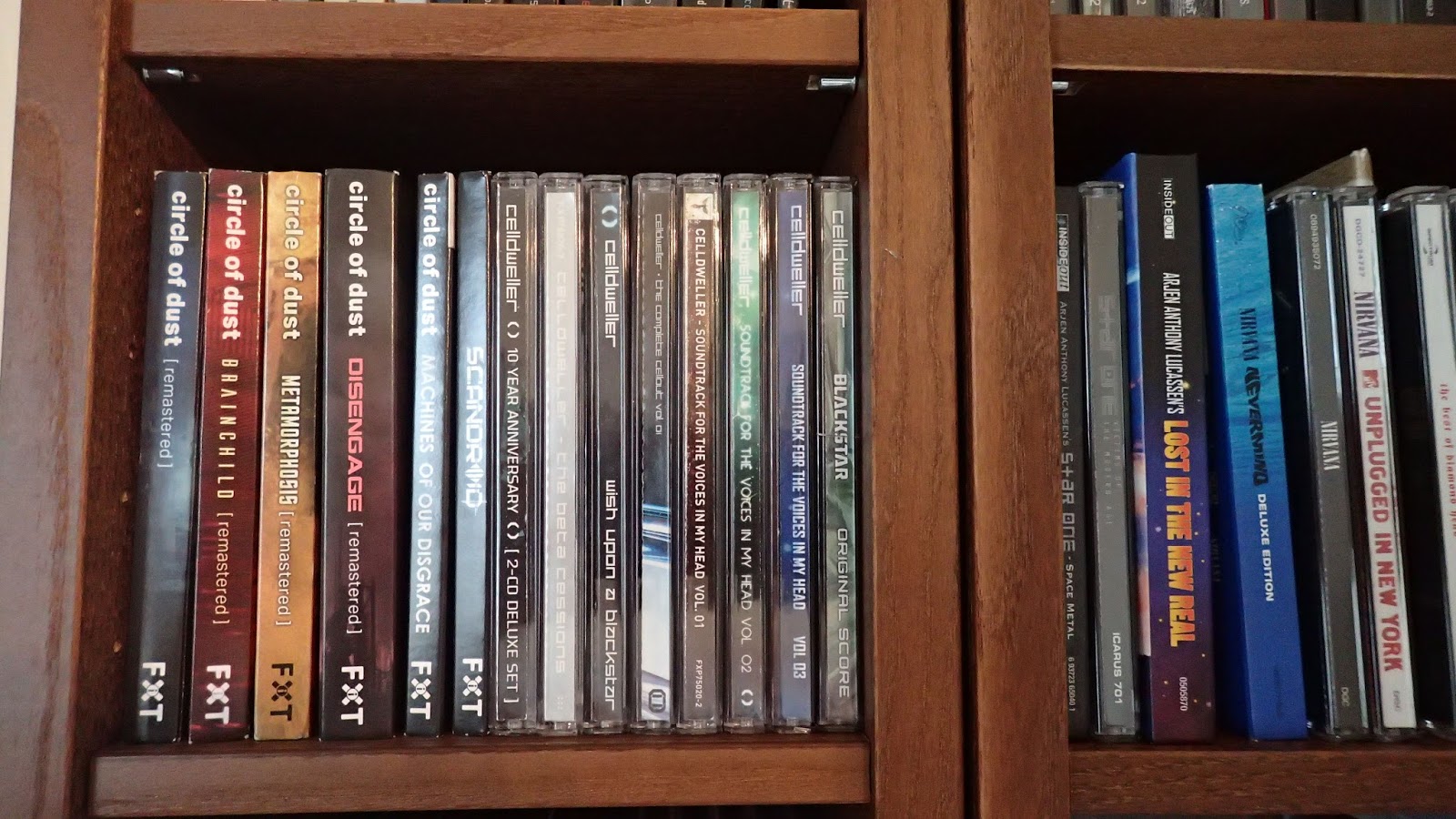
My goal in separating out the physical CDs in my collection is primarily to make it easier to grab them when I need them. I could always just play these digitally, but I will always prefer a physical disc so I can bring them to the office if I want to, and to own quality recordings that are a grade higher in bitrate than an MP3 download (I know vinyls are supposed to sound better yet and probably hold more information or have a greater dynamic range--they never interested me though because of the inherent noise (the scratches, pops, clicks) you get from them, and because I was never married to the analogue sound the way other music connoisseurs seem to be). I also realized it would look nice to have all my favorites put back in real CD cases (as opposed to thinner jewel sleeves) and have their spines visible on a shelf, especially next to all the digipak ones I have.

The requisite I have for these specific CDs is that they have to be ones I can listen to beginning-to-end without feeling the need to skip tracks. They shouldn't have songs I dislike. If they have filler, it might be filler I can enjoy or listen to all the same. Most importantly though, these should be albums that represent a whole sound or feeling I can't get from any other band or act. As much as I like music that's catchy, hooks and melodies alone might not always cut it--these are albums that need to linger in my mind through their atmospheres, lyrical qualities, structure, or any number of other aspects that make them stand out.

In some cases, I've sought out special editions with bonus tracks, more songs, demos, and other goodies. For the most part, these offer more of a good thing. Instrumental variations on whole albums are especially desirable--for writing, it's perfect to have the music without words.

So, to inspire my writing and help stir the mind and soul, these are the music albums I've put on the shelf. Maybe you'll find something here worth checking out as well--these all get my recommendation.

Classical Music:
  • Carl Orff - Carmina Burana
Downtempo / Trip-Hop:
  • Baxter
  • DJ Shadow - Endtroducing...
  • DJ Shadow - The Private Press
  • Massive Attack - Blue Lines
  • Massive Attack - Collected (Greatest Hits)
  • Massive Attack - Mezzanine
  • Massive Attack - 100th Window
  • Massive Attack - Protection
  • Massive Attack - Unleashed (Film Score)
  • Massive Attack vs Mad Professor - No Protection 
  • Pale 3 and Michael Brook - The Princess and the Warrior (Film Soundtrack)
  • Thievery Corporation - The Cosmic Game
  • Thievery Corporation - Culture of Fear
  • Thievery Corporation - The Mirror Conspiracy
  • Thievery Corporation - Radio Retaliation
  • Thievery Corporation - Richest Man in Babylon
  • Thievery Corporation - Sounds from the Thievery Hi-Fi
  • Thievery Corporation - Temple of I & I
  • Various Artists - Pure Chill Out Volumes 1, 2, 3, 4
Electronica:
  • Afro-Celt Sound System - Capture 1995 - 2010 (Greatest Hits) 
  • BT - This Binary Universe
  • The Crystal Method - London (Film Soundtrack)
  • The Crystal Method - Vegas [Deluxe Edition] 
  • Daft Punk - Musique Volume 1 1993 - 2005 (Greatest Hits)
  • Deadmau5 - 5 Years Of Mau5 (Greatest Hits)
  • Deadmau5 - While(1<2)
  • Death In Vegas - Dead Elvis
  • The Glitch Mob - Drink the Sea
  • The Glitch Mob - Love Death Immortality
  • Groove Armada - Goodbye Country, Hello Nightclub
  • Groove Armada - The Remixes
  • Groove Armada - Vertigo
  • Kosheen - Damage
  • Kosheen - Independence
  • Kosheen - Kokopelli
  • Kosheen - Resist
  • Kosheen - Solitude
  • Leftfield - Leftism
  • Leftfield - Rhythm and Stealth
  • Lindsey Stirling [With Bonus Tracks] 
  • Moby - Play
  • Moby - Play: The B Sides
  • Orbital - Work 1989 - 2002 (Greatest Hits) 
  • Overseer - Wreckage
  • The Prodigy - The Fat of the Land
  • Röyksopp - Melody AM [Deluxe Edition]
  • Röyksopp - The Understanding
  • Various Artists - The Animatrix (Film Soundtrack)
  • Various Artists - Requiem for a Dream: Remixed (Film Soundtrack)
Jazz:
  • The Cinematic Orchestra - Every Day 
  • The Cinematic Orchestra - Ma Fleur 
  • The Cinematic Orchestra - The Man With a Movie Camera
  • The Cinematic Orchestra - Motion
  • St. Germain - Tourist
Metal (Classic / Hair):
  • Black Sabbath [Deluxe Edition]
  • Black Sabbath - Master of Reality [Deluxe Edition]
  • Black Sabbath - Paranoid [Deluxe Edition]
  • Budgie - The Best Of
  • Def Leppard - Hysteria [Deluxe Edition] 
  • Def Leppard - Rock of Ages (Greatest Hits)
  • Diamond Head - Greatest Hits
Metal (Nu / Gothic):
  • Drowning Pool - Desensitized
  • Drowning Pool - Sinner 
  • Evanescence [Deluxe Edition]
  • KoRn - Greatest Hits Volume 1 
  • Lacuna Coil - Broken Crown Halo
  • Lacuna Coil - Comalies [Deluxe Edition]
  • Lacuna Coil - Dark Adrenaline
  • Lacuna Coil - Delirium [Deluxe Edition]
  • Lacuna Coil - The EPs (Lacuna Coil and Halflife) 
  • Lacuna Coil - In a Reverie
  • Lacuna Coil - Karmacode
  • Lacuna Coil - Shallow Life [Italian Import with Bonus Tracks]
  • Lacuna Coil - Unleashed Memories
  • Limp Bizkit - Gold Cobra 
  • Limp Bizkit - Greatest Hitz
  • Linkin Park - A Thousand Suns
  • Linkin Park - Hybrid Theory [Japanese Import with Bonus Tracks]
  • Linkin Park - Meteora
  • Linkin Park - Minutes to Midnight [Tour Edition]
  • Linkin Park - Reanimation
  • Linkin Park - Underground X: Demos
  • Linkin Park - Underground Eleven
  • Linkin Park - Underground XIII
  • Tiamat - Skeleton Skeletron
  • Various Artists - Heavy Metal 2000 (Film Soundtrack)
  • Various Artists - Queen of the Damned (Film Soundtrack)
Metal (Industrial):
  • Argyle Park - Misguided [Deluxe Edition] 
  • Celldweller [10th Anniversary Edition]
  • Celldweller - The Beta Cessions
  • Celldweller - Blackstar (Original Score)
  • Celldweller - The Complete Cellout Volume 1
  • Celldweller - End of an Empire [Deluxe Edition]
  • Celldweller - Soundtrack for the Voices in My Head Volumes 1, 2, 3
  • Celldweller - Wish Upon a Blackstar
  • Circle of Dust [Deluxe Edition]
  • Circle of Dust - Brainchild [Deluxe Edition]
  • Circle of Dust - Disengage [Deluxe Edition]
  • Circle of Dust - Machines of Our Disgrace
  • Circle of Dust - Metamorphosis [Deluxe Edition]
  • Collide - Chasing the Ghost
  • Collide - Some Kind of Strange
  • Collide - Two Headed Monster
  • Emigrate - Silent So Long
  • How to Destroy Angels [EP]
  • How to Destroy Angels - Welcome Oblivion
  • Nine Inch Nails - The Downward Spiral [Deluxe Edition]
  • Nine Inch Nails - The Fragile
  • Nine Inch Nails - Further Down the Spiral
  • Nine Inch Nails - Ghosts I - IV
  • Nine Inch Nails - Hesitation Marks [Deluxe Edition] 
  • Nine Inch Nails - Pretty Hate Machine
  • Nine Inch Nails - The Slip
  • Nine Inch Nails - Things Falling Apart
  • Nine Inch Nails - With Teeth [UK Import with Bonus Tracks]
  • Nine Inch Nails - Year Zero
  • Rammstein - Stripped [Single]
  • Various Artists - Spawn (Film Soundtrack)
Metal (Progressive):
  • Arjen Anthony Lucassen - Lost in the New Real 
  • Star One - Space Metal [Limited Edition]
  • Star One - Victims of the Modern Age [Limited Edition] 
  • Tool - 10,000 Days
Metal (Symphonic):
  • After Forever - Mea Culpa (Greatest Hits) 
  • Apocalyptica - Worlds Collide 
  • Luciferian Light Orchestra
  • Nightwish - Imaginaerum [Deluxe Edition]
  • Nightwish - Dark Passion Play [Deluxe Edition]
  • Nightwish - Once
  • Sirenia - An Elixir for Existence
  • Sirenia - At Sixes and Sevens
  • Tarja - Colours in the Dark
  • Therion - A'Arab Zaraq Lucid Dreaming
  • Therion - The Crowning of Atlantis
  • Therion - Deggial
  • Therion - Lemuria
  • Therion - Lepaca Kliffoth
  • Therion - Secret of the Runes
  • Therion - Sirius B
  • Therion - Theli [Deluxe Edition]
  • Therion - Vovin
  • Tristania - Ashes
  • Tristania - Beyond the Veil
  • Tristania - Illumination
  • Tristania - Widow's Weeds
  • Tristania - World of Glass
Musicals:
  • Jeff Wayne - War of the Worlds
  • Jeff Wayne - War of the Worlds: The New Generation
  • Justin Hurwitz - La La Land (Film Soundtrack)
Pop:
  • Chumbawamba - Tubthumper [Japanese Import with Bonus Tracks]
  • The Corrs - Forgiven Not Forgotten
  • The Eurythmics - For Love of Big Brother (1984 Film Soundtrack)
  • The Gorillaz - Demon Days
  • Madonna - Ray of Light
  • Sting - Brand New Day
  • Various Artists - Guardians of the Galaxy: Awesome Mix Vol. 1 (Film Soundtrack) [Deluxe Edition]
Rap:
  • Beastie Boys - Solid Gold Hits
  • Die Fantastichen Vier - Ernten Was Wir Säen [Single]
Rock:
  • Anti-M - Damage
  • Blue Man Group - Audio
  • Blue Man Group - The Complex 
  • David Bowie - All Saints (The Instrumentals)
  • David Bowie - Nothing Has Changed (Greatest Hits)
  • Ian Brown - Golden Greats 
  • Journey - Essential Journey (Greatest Hits)
  • Led Zeppelin - Mothership (Greatest Hits)
  • Scandroid
  • Siouxsie and the Banshees - The Best Of [Deluxe Edition] 
  • Sunhouse - Monkey Dead [Single]
  • The White Stripes - Elephant
  • The White Stripes - Icky Thump
  • The Who - Quadrophenia [Deluxe Edition]
Rock (Grunge):
  • Nirvana
  • Nirvana - Nevermind [Deluxe Edition]
  • Nirvana - Unplugged in New York [Live]
  • Pearl Jam - Ten [Deluxe Edition]
Rock (Hard):
  • Alice in Chains - The Devil Put Dinosaurs Here
  • Morningwood 
  • Rage Against the Machine
  • Rage Against the Machine - The Battle of Los Angeles 
  • Rage Against the Machine - Evil Empire
  • Rage Against the Machine - Renegade
  • Shinedown - Us and Them
  • Tenacious D - The Pick of Destiny
  • Van Halen - Best of Both Worlds (Greatest Hits)
  • Wolfmother 
  • The Yeah Yeah Yeahs - Fever To Tell
  • The Yeah Yeah Yeahs - Isis
  • Various Artists - Snakes on a Plane: The Album (Film Soundtrack)
Score Music:
  • Akira Yamaoka - Silent Hill Sounds Box (Video Game Scores) [Japanese Import]
  • Basil Poledoris - Conan the Barbarian (Film Score) [Deluxe Edition]
  • Bear McCreary - Battlestar Galactica Seasons 1 - 4 (TV Score)
  • Bear McCreary - Battlestar Galactica: The Plan / Razor (Film Score)
  • Brain, Marc Canham, and Nathan Johnson - Infamous: Second Son (Video Game Score)
  • Clint Mansell - Doom (Film Score)
  • Clint Mansell - The Fountain (Film Score) 
  • Clint Mansell and the Kronos Quartet - Requiem for a Dream (Film Score)
  • The Dust Brothers - Fight Club (Film Score) 
  • Graeme Revell - Red Planet (Film Soundtrack)
  • Hans Zimmer - Interstellar (Film Score)
  • Hans Zimmer - Man of Steel (Film Score) [Deluxe Edition]
  • Howard Shore - Lord of the Rings: The Fellowship of the Ring (Film Score)
  • Howard Shore - Lord of the Rings: The Fellowship of the Ring (Film Score) [Complete Recordings]
  • Howard Shore - Lord of the Rings: The Two Towers (Film Score) 
  • Howard Shore - Lord of the Rings: The Two Towers (Film Score) [Complete Recordings]
  • Howard Shore - Lord of the Rings: Return of the King (Film Score)
  • Howard Shore - Lord of the Rings: Return of the King (Film Score) [Complete Recordings]
  • Jeremy Soule - Elder Scrolls V: Skyrim (Video Game Score)
  • John Williams - Star Wars Episode I: The Phantom Menace (Film Score)
  • John Williams - Star Wars Episode IV: A New Hope (Film Score) [Special Edition]
  • Masara Nishida - Burst Angel (TV Score) [Perfect Edition] 
  • Steve Jablonsky - Pain & Gain (Film Score)
  • Tomandandy - Resident Evil: Afterlife (Film Score)
  • Toto - Dune (Film Score)
  • Trent Reznor and Atticus Ross - Girl With the Dragon Tattoo (Film Score)
  • Trent Reznor and Atticus Ross - Gone Girl (Film Score)
  • Trent Reznor and Atticus Ross - The Social Network (Film Score)
  • Tyler Bates and Joel R. Richard - John Wick (Film Soundtrack)
  • Vangelis - Blade Runner (Film Score) [25th Anniversary Edition]
  • Yasushi Ishii - Hellsing: Raid (TV Score)
  • Yasushi Ishii - Hellsing: Ruins (TV Score)
  • Yuki Kajiura - Blanc Dans Noir (TV Score) 
  • Yuki Kajiura - Madlax Volumes 1 and 2 (TV Score)
  • Yuki Kajiura - Noir Volumes 1 and 2 (TV Score)
Mixed Genre Albums:
  • Various Artists - CSI: Crime Scene Investigation (TV Soundtrack)
  • Various Artists - The Saint (Film Soundtrack)
  • Various Artists - Tomb Raider (Film Soundtrack)
  • Various Artists - Tomb Raider: The Cradle of Life (Film Soundtrack)
Digital Albums That Would Be On The Shelf:
  • Blue Stahli - Antisleep Volumes 1 - 4
  • Celldweller - The Terraform Drums Volume 1
  • Celldweller - Time and Space [Expanded Edition]
  • Celldweller - Transmissions Volumes 1 - 4
  • Celldweller - Zombie Killer (Video Game Score)
  • Cliff Martinez - The Neon Demon (Film Score)
  • Cliff Martinez - Solaris (Film Score)
  • Darren Korb - Transistor (Video Game Score)
  • DJ Shadow - Pre-Emptive Strike
  • The Glitch Mob - Piece of the Indestructible [EP]
  • The Glitch Mob - We Can Make The World Stop [EP]
  • John Carpenter - Lost Themes 
  • Juno Reactor - Beyond the Infinite
  • Juno Reactor - Bible of Dreams
  • Juno Reactor - The Golden Sun of the Great East
  • Linkin Park - Hybrid Theory [EP]
  • Linkin Park - Underground 2 - 16
  • Massive Attack - Ritual Spirit [EP]
  • Paul Leonard-Morgan - Dredd (Film Score)
  • Phutureprimitive - Kinetik

November 17, 2013

Writing: Sketches from the Void

Even though my own drawing skills are very amateurish, I do endeavor to sketch out certain scenes and designs from my work from time to time.  For my current novel in progress, Void, it's somewhat helpful and important to draw out what a starship, an alien, a planet, or any number of other futuristic things could look like.

Thus far, I've taken the time to make the following sketches, to help visualize certain scenes and figure out what certain things might look like.  They aren't anything terribly great or detailed, but by my standards, I'm fairly proud of them.
Above is the dorsal (top) hull of the Sprite V1 starfighter, the main fighting machine used by the characters in the story.  You'll notice that unlike the fighters you see in things like Star Wars or Battlestar Galactica, there is no transparent canopy.  The idea here is that the pilots are encased in a totally opaque and heavily-shielded cockpit, and the walls project the image of the exterior (with relevant HUD overlays).  This fighter is also directly controlled by the pilots' brainwaves, so most information (such as speed, direction, distance, danger, etc) can be pumped directly into the pilots' senses.  In this specific scene, I have this fighter floating through a nebula (all the weird blobby things in the background), but I currently have no specific place in mind yet.
This was an older drawing I made, in an attempt to conceptualize the enemy craft.  I thought it would be far more menacing and interesting to make the ship less mechanical and more organic in nature.  At the time, I didn't have any specific idea of what the hull's composition would be or how it works; it would be completely alien, for all intents and purposes.
In this close-up of the alien ship's tentacle-like structures, which I've drawn as having a mechanical-looking exterior, but with an organic-looking shape.  Upon drafting the book, I've described this as having neutronium hulls (the same substance as what's found on neutron stars, which are super-dense), but are flexible enough to move and "breathe" like an organism.  These structures can suck in and absorb ambient light and energy from the universe to fuel the rest of the vessel.
The alien vessels in this story can destroy planets with shocking ease, thanks to a special invisible whip-like weapon.  The idea is that it strings together a long chain of ionized particles, and makes each particle so dense that it carries its own gravity.  It's a thin thread so dense and disruptive that it can cleave entire planets, or entire groups of spaceships, with just a few lashes.
In one of the major battle scenes, a group of starships are able to defend a planet from alien attack.  Even though the enemy hulls are made from neutronium, the other ships are able to modify their weapons to penetrate the dense armor.  They make short work of the first enemy craft, but more follows.
The face of the enemy:  The Korzoch.  As part of the story, these aliens evolved on a rogue planet that orbits a black hole (in theory, live evolved on the planet totally independent from a light source with matter that accreted around the black hole falling on the planet and evolving into strange, scary-looking things).  As a result, the Korzoch evolved into a nocturnal race, with just a single optical visor-like eye across their faces.  Their heads are covered by a weird hood of skin, much like the hood of a cobra.  Their bodies are pretty fleshy and somewhat flexible, and they'd have a tail growing out of them.  Even though they appear humanoid, the closest thing they could be classified as would be like a worm with a head, hands, and feet.

Those are the best drawings I've done so far on this project, and there is a chance I might make more.

If you have even the most basic drawing ability, I certainly encourage you to make sketches of scenes, characters, objects, and other things from your story.  You may find that drawing out a vague idea from your head can give it a shape and form you may not expect, or might find appealing.  It's a good way to let your imagination run free, and it could help come up with new things to insert into your own project.

December 4, 2012

Writing: Finding the Time

One thing I often hear from other people is that they never find the time for proper writing.  And it's a perfectly understandable problem:  it takes hours and hours and hours to write out a full-length novel.  Even a good short story will take time to draft, proofread, rewrite, and submit.  When you have a day job, or a family to provide for, or a really busy social life, or you're on the road a lot, it will be near impossible to find the time to sit down at a desk in a totally distraction-free environment.

With life itself sucking up all the hours of a day, how does one find time to write anything?

There are ways.  If anything, doing the National Novel Writing Month challenge has taught me that it's not too hard to squeeze in 1,667 words a day for a straight month.  Here are my views and tips for finding the time to write:

First and foremost, you need the discipline.  Not everybody has the fortitude to sit down for hours on end; writing can be a rather tedious and lonesome hobby.  You'd have to be really motivated by your story ideas and imagination; it will need to possess you to try and express your ideas in words.  So before you really devote yourself to a project, you'll need to ask the hard question:  do you have what it takes to write? Are you the right person for a given story?

If you're past that point, then you may want to consider setting up a proper timeframe to tackle your writing.  Maybe you can block off a couple of hours every evening.  Maybe in the morning.  Noontime.  Before, after, and heck maybe even during work.  If you set aside the time, you can let your friends and family know that it is your time and you don't want to be disturbed under any circumstances; so long as they're trustworthy, you should have the peace and quiet you want.

If you're just so busy that there's absolutely no time you can block off for yourself, then you'll just have to wing it.  I personally carry around a notebook everywhere I go (to work, on trips, in town etc), so I can draft things by hand if I have any down time.  Transferring hand-written text to the computer takes hardly any time or brainpower, so if anything, it helps in the long run.  I also endeavor to keep a smaller notebook in my pocket at all times, to jot down any additional ideas that may come to me throughout the day.

All that being said, it can still be difficult to produce anything, even if you do carry around a notebook or block off time for yourself.  Inspiration and motivation can hit you at any time, and it won't always synchronize with your schedule.  Another writer I met referred to these feelings as "hauntings," because the urge to write can haunt you.  Ideally, you should probably run to the nearest computer and write your story right when the "hauntings" happen, but if this is the middle of the night or in the middle of work or something, you'll just have to wait.  Or, you may have to improvise and write in a notebook or something.  Either way, flexibility in your routine may help you.  It may also behoove you to seek some other form of inspiration to cut through any blocks you may have.  In the end, however, you'll never be able to create a system that aligns perfectly with your "hauntings," so it's best to build the discipline in some form or another.

Once you get started, it may help to establish a deadline.  Try and shoot for so many words in a day.  Try and finish something by the end of the month.  Having a deadline may motivate you to get the story pumped out.  If you write 1,667 words a day, you'll have 50,000 by the end of the month; that's only six pages a day.  You might seriously surprise yourself with how many words you can fit into a few hours' work.

Even if you peck at it little by little, you will accomplish something and be well on your way to producing a tangible manuscript.