When it comes to works of fantasy and myth, it takes effort to relay the sense of wonder or whimsey that accompanies such things as magic or otherworldly creatures. It's always been easy to relay such things through books, poetry, or even reciting it verbally to others. On film, it's a far bigger challenge, and 1924's The Thief of Bagdad stands as one of the earliest and most ambitious attempts to conceptualize and execute a work of fantasy for the big screen. It's a big production, with huge sets, a huge crowd of extras, lavish costumes, and convincing special effects. It all works together to bring to life a fantastic world of flying carpets, magic ropes, mermaids, giant apes, and invading foreign armies, all contained within an exotic Arabian backdrop.
The film is pretty long, and it drags at certain parts (mostly the middle). However, it does have a lighthearted whimsey to the tone, and in the characters, which keeps it entertaining and fun, even after all these years.
This story is a big and sprawling adventure, but thanks to the way it's told, with simple dialogue and exaggerated acting, it's never convoluted. It's successful at telling a complicated series of events without losing the audience, and with a cast of decent and lovable characters. I have no idea how this film compares to its original novel, but it appears to maintain the appropriate tone and all the right elements of a proper Arabian fantasy.
This film uses solid photography and editing. Acting is very exaggerated and over-the-top, which can be laughable at times, but for a silent film it's quite forgivable. Writing is simple but effective enough. This production has huge sets, props, and costumes; a lot of it seems to reflect a more stereotypical view of Arabian and Asian culture, rather than trying to be anything realistic. Special effects are great though; even after all these years, there are many shots that you can look at and wonder, how did they do that? In spite of that, the imagery is often great. The music score is great too.
The Thief of Bagdad is not only a seminal classic for fantasy films, it's also one of the biggest and most imaginative silent-era films I've seen.
Recommended!
4.5/5 (Entertainment: Good | Story: Very Good | Film: Very Good)
July 7, 2013
Video: 4th of July Fireworks
The other day, everybody in the nation was out celebrating the 4th of July. The United States is going on 237 years old; what better way to celebrate than to break out the fireworks and watch them fly, explode, and sparkle in all brilliant shapes and colors?
People were out in my neighborhood, lighting these things on the street, in the parks, and in the yards. There were fireworks all around, so I took my camera and tried to capture as many as I could. It's pretty difficult to get good shots of fireworks; the light is so dark by this time that the camera can't focus that well on all these flashes and sparkles. Still, I managed to get enough footage for a lengthy clip. I've assembled it here, for all to enjoy.
July 6, 2013
Film Review: The Lone Ranger (2013)
"There come a time, when good man must wear mask." - Johnny Depp
I am not a fan of westerns, not by a long shot. What few I like are a very specific few, but most strike me as being long, dry, and boring. I certainly never gave a flying rip about The Lone Ranger. Sure, I recognize the references that have permeated in modern pop culture over the decades; we all know of the mask, the horse named Silver, the Indian dude, and the William Tell overture. For whatever reason, I never had an interest in the franchise, until now.
As it stands, 2013's The Lone Ranger is easily one of the most exciting and evenly-entertaining westerns I've seen. It has big action, often venturing into realms of big-scale absurdity that's become commonplace in modern blockbusters. It has comedy; the interplay between the Ranger and Tanto is often amusing, and fills up the spaces between the action really well. Despite the comedy, the film is also pretty gritty and rough: there is a fairly high body count in this film, and it often pushes the boundaries of its PG-13 rating. Overall, it's a long feature, but I was engrossed in it the whole time.
I was equally engrossed in the story. It gets a little wonky, given the unique narrative structure; this is one of those stories that's bookended by a character telling a story, with asides, flashbacks, and flashforwards at key moments. A few scenes are made a little sloppy this way, and a few pressing questions remain unanswered (how did Tanto get out of jail?). The film also gets predictable at times, and the standard western elements are dispensed liberally throughout. However, I still felt that this was a dense and well-built plot. I'm especially pleased with the characters; they are colorful and fun, but also show enough depth and emotion to make them memorable and relevant. The standard western themes of justice and civility pop up on occasion.
This film uses some fantastic photography. Editing is okay, but a few scenes seem to be slapped together lazily. Acting is good: I thoroughly enjoyed the performances of Armie Hammer (who does his best to embody the look and mannerisms of the title character), Johnny Depp (who channels the same deadpan lunacy that made Jack Sparrow so fun), and everybody else. Writing is pretty decent. This production has great-looking sets, props, and costumes. Music is generally good, and toward the end, the William Tell overture is utilized liberally.
A lot of viewers and critics don't seem to like this film, but I really don't see that much wrong with it. I feel it does to westerns what Pirates of the Caribbean did to pirate movies; it's an exciting, refreshing piece of tall-tale escapism. For a western, I am especially pleased.
4.5/5 (Entertainment: Very Good | Story: Good | Film: Very Good)
I am not a fan of westerns, not by a long shot. What few I like are a very specific few, but most strike me as being long, dry, and boring. I certainly never gave a flying rip about The Lone Ranger. Sure, I recognize the references that have permeated in modern pop culture over the decades; we all know of the mask, the horse named Silver, the Indian dude, and the William Tell overture. For whatever reason, I never had an interest in the franchise, until now.
As it stands, 2013's The Lone Ranger is easily one of the most exciting and evenly-entertaining westerns I've seen. It has big action, often venturing into realms of big-scale absurdity that's become commonplace in modern blockbusters. It has comedy; the interplay between the Ranger and Tanto is often amusing, and fills up the spaces between the action really well. Despite the comedy, the film is also pretty gritty and rough: there is a fairly high body count in this film, and it often pushes the boundaries of its PG-13 rating. Overall, it's a long feature, but I was engrossed in it the whole time.
I was equally engrossed in the story. It gets a little wonky, given the unique narrative structure; this is one of those stories that's bookended by a character telling a story, with asides, flashbacks, and flashforwards at key moments. A few scenes are made a little sloppy this way, and a few pressing questions remain unanswered (how did Tanto get out of jail?). The film also gets predictable at times, and the standard western elements are dispensed liberally throughout. However, I still felt that this was a dense and well-built plot. I'm especially pleased with the characters; they are colorful and fun, but also show enough depth and emotion to make them memorable and relevant. The standard western themes of justice and civility pop up on occasion.
This film uses some fantastic photography. Editing is okay, but a few scenes seem to be slapped together lazily. Acting is good: I thoroughly enjoyed the performances of Armie Hammer (who does his best to embody the look and mannerisms of the title character), Johnny Depp (who channels the same deadpan lunacy that made Jack Sparrow so fun), and everybody else. Writing is pretty decent. This production has great-looking sets, props, and costumes. Music is generally good, and toward the end, the William Tell overture is utilized liberally.
A lot of viewers and critics don't seem to like this film, but I really don't see that much wrong with it. I feel it does to westerns what Pirates of the Caribbean did to pirate movies; it's an exciting, refreshing piece of tall-tale escapism. For a western, I am especially pleased.
4.5/5 (Entertainment: Very Good | Story: Good | Film: Very Good)
July 5, 2013
Travel: Utah State Route 92 (Alpine Loop)
The state of Utah is practically surrounded by mountains, and many of them offer ample opportunities for hiking, camping, biking, mountaineering, or any number of other outdoors activities. Since coming to this state, I was informed of something called the Alpine Loop, and I was compelled to drive through it at least once to see what views it has to offer.
Getting to the Alpine Loop is easy; you basically follow the Timpanogas Highway straight into the American Fork canyon. This highway starts around Thanksgiving Point, intersects the I-15, and it runs past the new Adobe building and past the new outlet developments. As you enter the canyon, there will be a booth to purchase passes for staying in the Uinta National Forest (rates can be found at the national forest's website, but they are also posted near the forest's entrance; it's like $6 for 1 - 3 days). However, if you want to just drive straight through the loop without stopping or recreating, you can pass through without having to pay.
The road cuts through the canyon for about five miles, before it starts ascending into the mountain. Along this path, the Timpanogos Cave can be found; it may be closed in the winter and spring, but is open throughout the summer. I did not stop for the cave this time around, but it was clearly open, and there were a lot of people parked around it. All along the road, there are also places to pull aside, and quite a few areas to park and have a picnic. Walking trails in these areas are short and limited. A few branching roads also lead to campgrounds.
Further up, the road becomes steeper and a lot curvier. You do have to drive cautiously, for the turns are tight, the road becomes narrower, and you may need to give oncoming traffic some room to pass by. A few more miles up this road, and there's a parking place with a gorgeous vantage point of Mount Timpanogos and the surrounding landscapes. This is a good place to stop for a respite, and there are longer hiking paths around this area. In the spring, this might be as far as you can go; snow can remain in the mountains until June or July, so it's possible that the road will be closed from this point onward (the ranger at the shack at the beginning of the park should let you know).
If you are able to continue, you can continue climbing up the mountain in a long and winding length of road. At one point, you'll reach the summit trailhead, where you can stop, park, and take one of several hiking paths branching out to different areas. Some of these paths can be short, just a few miles; others can go on for fourteen miles or so. These paths are usually marked with corresponding numbers and names, and a plaque will inform you as to whether the paths are suitable for hiking, biking, horseback riding, or whatever.
On this trip, I stopped here and took a path that looped around for a few miles or so. The path led me through fields of lush green grass with pockets of colorful flowers everywhere. At times, the path cut through dense groves of aspen trees. It became strenuous with some steep inclines, which eventually led me to a high vantage point where I could see more of the surrounding mountains. It wasn't a long hike, but it was hot, tiring, and satisfying.
Returning to the car, I followed the road again. It continued past the mountains and started to slope downward; I was descending down the other side. There are more rugged views along the way, with some areas to stop if need be. There are more campgrounds to be found. Another ten miles or so, and you'll eventually leave the Uinta National Forest, passing by another booth. From then on, you'll pass by the Sundance ski resort, and a number of more expensive mountain homes. Eventually, the road will end at the US-189 East Provo Canyon Road; you'd turn right to travel out of the canyon and drive into either Provo or Orem. Turning left will lead to the Deer Creek Dam, which I didn't bother visiting this time around (I'm told that there's nothing much to see there, other than to stop for a quick picture or something).
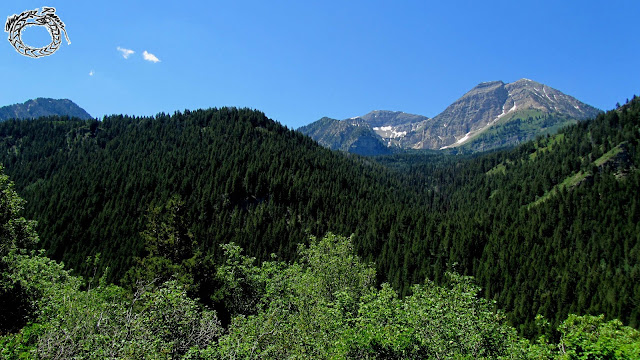
This short adventure only took up a few hours, but it did have some decent scenic views and photo opportunities. Whether venturing out for a quick drive-through, or setting out on an outdoors adventure, the Alpine Loop is good for a short getaway.
![]() |
| The Alpine Loop highlighted in blue. |
Further up, the road becomes steeper and a lot curvier. You do have to drive cautiously, for the turns are tight, the road becomes narrower, and you may need to give oncoming traffic some room to pass by. A few more miles up this road, and there's a parking place with a gorgeous vantage point of Mount Timpanogos and the surrounding landscapes. This is a good place to stop for a respite, and there are longer hiking paths around this area. In the spring, this might be as far as you can go; snow can remain in the mountains until June or July, so it's possible that the road will be closed from this point onward (the ranger at the shack at the beginning of the park should let you know).
If you are able to continue, you can continue climbing up the mountain in a long and winding length of road. At one point, you'll reach the summit trailhead, where you can stop, park, and take one of several hiking paths branching out to different areas. Some of these paths can be short, just a few miles; others can go on for fourteen miles or so. These paths are usually marked with corresponding numbers and names, and a plaque will inform you as to whether the paths are suitable for hiking, biking, horseback riding, or whatever.
On this trip, I stopped here and took a path that looped around for a few miles or so. The path led me through fields of lush green grass with pockets of colorful flowers everywhere. At times, the path cut through dense groves of aspen trees. It became strenuous with some steep inclines, which eventually led me to a high vantage point where I could see more of the surrounding mountains. It wasn't a long hike, but it was hot, tiring, and satisfying.
Returning to the car, I followed the road again. It continued past the mountains and started to slope downward; I was descending down the other side. There are more rugged views along the way, with some areas to stop if need be. There are more campgrounds to be found. Another ten miles or so, and you'll eventually leave the Uinta National Forest, passing by another booth. From then on, you'll pass by the Sundance ski resort, and a number of more expensive mountain homes. Eventually, the road will end at the US-189 East Provo Canyon Road; you'd turn right to travel out of the canyon and drive into either Provo or Orem. Turning left will lead to the Deer Creek Dam, which I didn't bother visiting this time around (I'm told that there's nothing much to see there, other than to stop for a quick picture or something).
This short adventure only took up a few hours, but it did have some decent scenic views and photo opportunities. Whether venturing out for a quick drive-through, or setting out on an outdoors adventure, the Alpine Loop is good for a short getaway.
Location:
Route 92, UT, USA
Film Review: White House Down
Earlier this year, Olympus Has Fallen was released showcasing a lone hero rising to one of the boldest and most terrifying challenges: saving an entire nation when the White House and its members fall under attack. It's not a terribly great or well-made film, but it sure was entertaining, representing the essence of action cinema.
Strangely, White House Down was released just a few months afterward, also portraying the White House and the President under attack. Coming from director Roland Emmerich, the man behind Independence Day and 2012, WHD embodies the thing that Emmerich does best: the essence of blockbuster cinema.
In spite of that, you can expect plentiful amounts of action: there are numerous thrilling shoot-outs and crisis situations. Special effects are moderately-used, but look pretty decent. Witty quips and humor break up nearly every scene. It takes a little while in the first act for the action to pick up, but once it does, it's a very evenly-paced and satisfying thrill ride.
The story in this movie bears much in common with OHF, but with enough subtle differences to warrant endless comparisons. Basically, WHD follows several characters, who are all endearing, but show minimal development. The film does a great job of establishing the main hero, his dilemmas, and his bonds with the other characters, which ultimately raise the stakes on a more personal level. The story may cover some unlikely ground (and it gets a little pushy with the left-wing politics), but the plot is well-structured. It's actually quite an improvement from OHF, which presented problems that were solved one-after-another; WHD keeps all the conflicts running hard and fast until the very end, making it all the more gripping.
This film looks decent, with quality photography and editing. Acting is generally good; nobody puts on a serious face here, but everybody works to make the film fun and light. Writing is good and seems well-researched (another improvement from OHF). This production has nice-looking sets, props, costumes, and special effects. Music is good too.
OHF was good as an action movie for tough guys, but WHD works best as an audience-friendly popcorn flick. In fact, OHF reminded me so much of action movies of the 80s and 90s (like Die Hard, Under Siege, etc), but WHD reminded me more of the great thrillers and blockbusters of the 90s (such as a Jack Ryan feature, or the earlier works of Emmerich). Between the two, I actually do prefer WHD by a slight margin, and of the two, it comes the most recommended.
4/5 (Entertainment: Very Good | Story: Pretty Good | Film: Good)
July 4, 2013
Film Review: Independence Day (ID4)
"Perhaps it's fate that today is the Fourth of July, and you will once
again be fighting for our freedom... Not from tyranny, oppression, or
persecution... but from annihilation. We are fighting for our right to
live. To exist. And should we win the day, the Fourth of July will no
longer be known as an American holiday, but as the day the world
declared in one voice: 'We will not go quietly into the night!' We will
not vanish without a fight! We're going to live on! We're going to
survive! Today we celebrate our Independence Day!" - Bill Pullman
In 1996, this film was released with a simple premise: an alien invasion occurs on July 4th, with massive ships obliterating entire cities and systematically exterminating mankind. In some of the most chilling and awe-inspiring footage, the 15-mile-wide flying saucers destroy the White House, Los Angeles, and New York City (just a few of many), with massive waves of fire washing over the streets. This is quickly followed by retaliation, with squadrons of jet fighters taking on the extraterrestrial vessels.
This film crams in a lot within its two-and-a-half hour timeframe: the first act takes its time to establish all the key characters as the UFOs gradually take position. When the attack begins, the action remains pretty constant, leading up to a grand final battle. Special effects were really inspiring at its time, and remain iconic to this day. Even when firestorms, alien ships, and jet fighters aren't filling up the screen, the movie runs pretty fast, with frequent comedy to keep things light and fun. Overall, it's the perfect blockbuster picture, finding a fine balance between action, spectacle, humor, and drama.
The story is pretty much more of the same as any other alien invasion story you see. In fact, it bears much in common with the classic War of the Worlds. What makes ID4 more compelling, however, is that it juggles multiple characters and multiple points of views, and eventually brings them together for the central fight. All these characters are pretty fun to watch and root for, and show just enough development to make them work. The plot is pretty well-structured, using three distinct acts to portray this larger-than-life situation. It's also most noteworthy for portraying relatively realistic politics and military protocols, thanks largely to the consultation the filmmakers received from the Air Force during filming. The film also ties in a few ufology aspects to capitalize off of the popular concepts of alien life. It makes for a grand and entertaining story, even if it isn't all that deep or original.
This film has very solid photography and editing. Acting is generally fun from the whole cast: Bill Pullman is probably the only one who takes his role seriously, and actually comes off as a little cheesy with the way he tries so hard to sound cool and tough. Will Smith and Jeff Goldblum steal the show the whole way with their lighthearted performances. Writing is pretty decent, although many lines are silly and goofy. This production spares no expense on sets, props, costumes, and special effects, although they are showing their age. David Arnold's music score is appropriately boisterous.
At the time of its release, Independence Day was one of the most exciting and awe-inspiring features I had seen. Despite its age and cheesiness, I still call it one of the most essential blockbusters of all time.
Recommended!
4.5/5 (Entertainment: Perfect | Story: Good | Film: Very Good)
In 1996, this film was released with a simple premise: an alien invasion occurs on July 4th, with massive ships obliterating entire cities and systematically exterminating mankind. In some of the most chilling and awe-inspiring footage, the 15-mile-wide flying saucers destroy the White House, Los Angeles, and New York City (just a few of many), with massive waves of fire washing over the streets. This is quickly followed by retaliation, with squadrons of jet fighters taking on the extraterrestrial vessels.
This film crams in a lot within its two-and-a-half hour timeframe: the first act takes its time to establish all the key characters as the UFOs gradually take position. When the attack begins, the action remains pretty constant, leading up to a grand final battle. Special effects were really inspiring at its time, and remain iconic to this day. Even when firestorms, alien ships, and jet fighters aren't filling up the screen, the movie runs pretty fast, with frequent comedy to keep things light and fun. Overall, it's the perfect blockbuster picture, finding a fine balance between action, spectacle, humor, and drama.
The story is pretty much more of the same as any other alien invasion story you see. In fact, it bears much in common with the classic War of the Worlds. What makes ID4 more compelling, however, is that it juggles multiple characters and multiple points of views, and eventually brings them together for the central fight. All these characters are pretty fun to watch and root for, and show just enough development to make them work. The plot is pretty well-structured, using three distinct acts to portray this larger-than-life situation. It's also most noteworthy for portraying relatively realistic politics and military protocols, thanks largely to the consultation the filmmakers received from the Air Force during filming. The film also ties in a few ufology aspects to capitalize off of the popular concepts of alien life. It makes for a grand and entertaining story, even if it isn't all that deep or original.
This film has very solid photography and editing. Acting is generally fun from the whole cast: Bill Pullman is probably the only one who takes his role seriously, and actually comes off as a little cheesy with the way he tries so hard to sound cool and tough. Will Smith and Jeff Goldblum steal the show the whole way with their lighthearted performances. Writing is pretty decent, although many lines are silly and goofy. This production spares no expense on sets, props, costumes, and special effects, although they are showing their age. David Arnold's music score is appropriately boisterous.
At the time of its release, Independence Day was one of the most exciting and awe-inspiring features I had seen. Despite its age and cheesiness, I still call it one of the most essential blockbusters of all time.
Recommended!
4.5/5 (Entertainment: Perfect | Story: Good | Film: Very Good)
July 1, 2013
Film Review: 300
"SPARTANS!!! Prepare for glory!!!" - Gerard Butler
Thousands of years ago, the Persian Empire threatened to trample over ancient Greece in a series of historic battles. The first such battle was Thermopylae; it was an incredible fight in which a small band of Spartan warriors held off a massive wave of Persian invaders for three days. Ancient accounts describe a barrage of arrows that literally blocked out the sun. Through the use of brilliant strategy, superior armor and weapons, and better training, the three hundred Spartans put up a heck of a fight against insurmountable odds. This battle was popularized throughout the ages; more recent tellings of the story include the 1962 film The 300 Spartans (which I found to be rather lame), and Frank Miller's graphic novel 300, which was influenced by that film.
The film 300 follows the graphic novel very closely, with additional embellishments to the story. In spite of that, the film presents a highly mythologized and exaggerated take on the Battle of Thermopylae; it's a fantastic, epic, and incredible spectacle to watch the brutal Spartans take on endless waves of Persian troops (including the Immortals, shown on screen as being literally monstrous). Barrages of arrows literally block out the sun. Strange creatures, including an orc-like giant, elephants, and a rhinoceros, charge into battle. Blood flies freely across the screen frequently; with a dark and brooding tone, the film overall is one of the most hard-edged and wickedest epics committed to film. It won't appeal to everybody, especially with the film's penchant for frequent slow-motion and CGI backgrounds, but at its time it was considered one of the awesomest and most macho films ever made.
Since this film is based on a graphic novel, it does take liberties with the historic facts. Obviously, the Spartans never fought without wearing armor; there never was a rhino in battle; Ephialtes was never a hunchback; the Immortals were actual men, not monsters; and so on. However, the film does get a few details surprisingly right; the events actually happened, the tactics appear mostly-sound, and the portrayal of Spartan upbringing is correct. The blending of historic fact with myth may not sit well with history buffs, but it makes for fantastic storytelling.
The story itself is well-structured, purposefully outlining the background of the battle and showing the assembly of the armies before breaking out in bloody mayhem. Characters aren't particularly likable (King Leonidas borders on being psychotic at times), but they are as badass as they come.
This film is overloaded with style, using slow-motion and animations in nearly every scene. With the film's framing and editing, however, it really does look like a graphic novel brought to life, and it's really cool that way. Acting is really extreme, almost to a ridiculous degree; Gerard Butler screams and scowls in every scene, but given the hardcore nature of his character and the material overall, he really nails the role. Everybody else fulfills their roles well. Writing is generally good; a lot of it matches up with Frank Miller's book, which in turn reflects some of the historical accounts. The use of narration is especially noteworthy, for it reinforces the film as fantastic storytelling. Tyler Bates' music score is really cool too.
Despite its liberties with the historic events, the 300 film remains the most thrilling, most awe-inspiring, and most uncompromising account of the Battle of Thermopylae. The whole film comes off as a wicked and badass experience; I personally wish more historic and fantasy films were made this way. If you can stomach the bloodshed and the excesses, this film comes recommended.
5/5 (Entertainment: Perfect | Story: Very Good | Film: Very Good)
Thousands of years ago, the Persian Empire threatened to trample over ancient Greece in a series of historic battles. The first such battle was Thermopylae; it was an incredible fight in which a small band of Spartan warriors held off a massive wave of Persian invaders for three days. Ancient accounts describe a barrage of arrows that literally blocked out the sun. Through the use of brilliant strategy, superior armor and weapons, and better training, the three hundred Spartans put up a heck of a fight against insurmountable odds. This battle was popularized throughout the ages; more recent tellings of the story include the 1962 film The 300 Spartans (which I found to be rather lame), and Frank Miller's graphic novel 300, which was influenced by that film.
The film 300 follows the graphic novel very closely, with additional embellishments to the story. In spite of that, the film presents a highly mythologized and exaggerated take on the Battle of Thermopylae; it's a fantastic, epic, and incredible spectacle to watch the brutal Spartans take on endless waves of Persian troops (including the Immortals, shown on screen as being literally monstrous). Barrages of arrows literally block out the sun. Strange creatures, including an orc-like giant, elephants, and a rhinoceros, charge into battle. Blood flies freely across the screen frequently; with a dark and brooding tone, the film overall is one of the most hard-edged and wickedest epics committed to film. It won't appeal to everybody, especially with the film's penchant for frequent slow-motion and CGI backgrounds, but at its time it was considered one of the awesomest and most macho films ever made.
Since this film is based on a graphic novel, it does take liberties with the historic facts. Obviously, the Spartans never fought without wearing armor; there never was a rhino in battle; Ephialtes was never a hunchback; the Immortals were actual men, not monsters; and so on. However, the film does get a few details surprisingly right; the events actually happened, the tactics appear mostly-sound, and the portrayal of Spartan upbringing is correct. The blending of historic fact with myth may not sit well with history buffs, but it makes for fantastic storytelling.
The story itself is well-structured, purposefully outlining the background of the battle and showing the assembly of the armies before breaking out in bloody mayhem. Characters aren't particularly likable (King Leonidas borders on being psychotic at times), but they are as badass as they come.
This film is overloaded with style, using slow-motion and animations in nearly every scene. With the film's framing and editing, however, it really does look like a graphic novel brought to life, and it's really cool that way. Acting is really extreme, almost to a ridiculous degree; Gerard Butler screams and scowls in every scene, but given the hardcore nature of his character and the material overall, he really nails the role. Everybody else fulfills their roles well. Writing is generally good; a lot of it matches up with Frank Miller's book, which in turn reflects some of the historical accounts. The use of narration is especially noteworthy, for it reinforces the film as fantastic storytelling. Tyler Bates' music score is really cool too.
Despite its liberties with the historic events, the 300 film remains the most thrilling, most awe-inspiring, and most uncompromising account of the Battle of Thermopylae. The whole film comes off as a wicked and badass experience; I personally wish more historic and fantasy films were made this way. If you can stomach the bloodshed and the excesses, this film comes recommended.
5/5 (Entertainment: Perfect | Story: Very Good | Film: Very Good)
Subscribe to:
Posts (Atom)


